Get Full Government Meeting Transcripts, Videos, & Alerts Forever!
Get email alerts on the Taxpayer Rights Advocate topic
No spam. Unsubscribe anytime.
Taxpayer Rights Advocate reports case loads, offers guidance on disaster relief and releases nonprofit exemptions info sheet
Summary
The TRA office reported monthly case totals, explained common case types (reassessment exclusions, change in ownership, penalties), advised taxpayers on Proposition 8 and 19 processes after disasters, and said a new nonprofit exemption information sheet will be published in September.
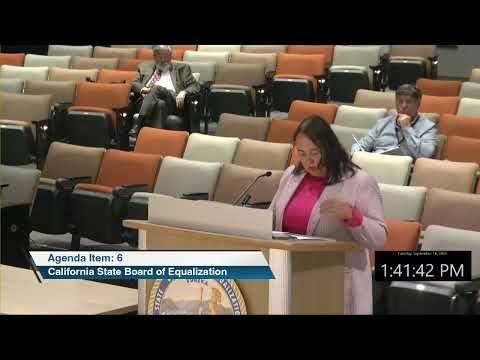
Lisa Thompson, chief of the Taxpayer Rights Advocate (TRA) office, told the State Board of Equalization on Sept. 16 that her office completed 43 cases in July and 27 in August and outlined where most work is concentrated.
Thompson said completed July cases totaled 43, of which 35 were valuation cases; the largest valuation topic was exclusions from reassessment (12 cases), followed by change in ownership (8). She reported for July that of the 12 exclusion cases, 7 involved transfers between parents and children and 4 were base‑year transfer matters for seniors (and 1 for a disabled person). For July, the highest completed administrative topic was penalties/penalty cancellations (5 cases). For August, Thompson reported 27 completed cases, 21 valuation; exclusions were again the highest valuation topic (7 cases — 1 parent‑child transfer, 5 base‑year transfers for disabled persons, and 1 new‑construction disaster relief exclusion).
Thompson said TRA staff responded to questions raised at a recent Taxpayer Bill of Rights hearing, and that the office provided taxpayers links to webcasts and timestamps where their written comments were read. She described how TRA staff advised one taxpayer that changing the property tax rate for a limited group would require a constitutional amendment, citing that “the property tax rate was set by the constitution, at the 1% tax rate plus voter approved indebtedness.” She also described advising taxpayers about Proposition 8 decline‑in‑value reviews and the county assessor informal decline-in-value process and assessment‑appeal applications.
Thompson recounted advising a taxpayer who asked about Proposition 19 base‑year transfers and who had purchased and sold property before Proposition 19’s effective date; TRA staff explained how excess market value on a replacement property and later new construction can affect the transferred base. She said TRA analyzed that taxpayer’s scenario and explained the hypothetical tax difference under Proposition 19 rules.
On administrative guidance, Thompson announced a new TRA information sheet on nonprofit organization exemptions to be published in September and an LTA (Letter to Assessors) to follow. The sheet, she said, will describe the church, religious and welfare exemptions, application and annual filing deadlines, rules for the welfare exemption (co‑administered by the BOE and county assessors), and requirements for an organization to hold an OCC for some welfare exemptions and an SCC for limited partnerships seeking the exemption for low‑income rental housing.
Board members asked questions. Member Schaeffer asked whether the low number of decline‑in‑value cases in July and August indicated that county assessors (for example, in Los Angeles County after fires) had been proactive; Thompson said Los Angeles County had acted quickly to remove improvements from assessments and provide guidance to taxpayers, but emphasized that site or land value may remain and explain why some taxpayers saw only partial relief. Member Vasquez asked about the mix of exclusion claims and whether specific exclusions drove recent increases; Thompson said parent‑child exclusions and base‑year transfers (especially for seniors) remain common and that some taxpayers lose eligibility due to homeowner‑exemption timing requirements.
Thompson closed by saying the nonprofit information sheet “should be posted today or tomorrow” and that an LTA would notify assessors and interested parties.