Get Full Government Meeting Transcripts, Videos, & Alerts Forever!
Get email alerts on the Legislation Disaster Relief topic
No spam. Unsubscribe anytime.
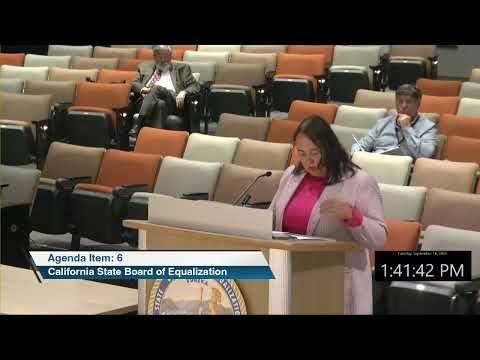
BOE legislative director briefs board on disaster-relief and Chiquita Canyon bills headed to governor
Summary
The board’s legislative director summarized a set of property-tax and disaster-relief bills that cleared the Legislature and are awaiting the governor’s action, including measures that extend base-year transfer relief for wildfire victims and a proposal allowing retroactive reassessments near the Chiquita Canyon landfill.
The State Board of Equalization’s legislative director told members on Sept. 16 that several bills affecting property tax administration and disaster relief have passed the Legislature and are headed to the governor’s desk.
The legislative update focused on disaster-response measures that would extend or clarify existing reassessment and base-year transfer rules for victims of fires and similar events, and on AB 985, a bill aimed at allowing reassessments for declining values near the Chiquita Canyon landfill.
Ted Angelo, legislative director and chief of the Legislative Research and Statistics Division, told the board, “The governor will have until October 13 to act on any bill that makes it to his desk.” He said three principal disaster-relief measures — AB 245, SB 293 and SB 663 — are among the bills that advanced and are intended to give affected taxpayers additional time or clearer authority for property tax relief after disasters. AB 245 would extend the period for base-year transfer claims for fire victims; SB 293 would expand the time frame to file certain ownership-change claims; and SB 663 includes technical fixes and clarifications tied to those measures.
Angelo also briefed members on AB 985, a measure specific to the Chiquita Canyon landfill, saying it would allow assessors to pursue reassessments for declining value dating back to 2022 within a defined radius of the landfill if evidence shows property values declined because of the event. He summarized the bill as giving property owners near the landfill an opportunity to seek reassessment where a toxic or traumatic incident materially reduced market value.
The briefing noted other items of interest: AB 1485 would clarify tax treatment for Native American land reacquisitions intended to remain open space; SB 710 addresses solar-energy exclusions (with some costlier provisions removed late in session); and SB 254, part of an energy package, could affect wildfire‑fund statutes established after the 2019 utility‑related wildfire losses. Angelo told the board that the wildfire fund created after the 2019 fires was substantially drawn down by recent claims and that late-session action was seeking to address the fund’s sunset or extension.
Members asked clarifying questions. Member Vasquez requested more detail on AB 985’s retroactivity and scope; Angelo said AB 985 would allow reassessment back to 2022 and would be limited by geography and the statutory language included in the bill. Vice Chair Lieber raised a related concern about rising groundwater and other environmental events that can depress property values in ways similar to the landfill issue, and asked staff to monitor analogous developments.
Board counsel and staff said they would continue to track implementing guidance and any Letters to Assessors (LTAs) that the board’s legal and property-tax divisions publish to explain judicial decisions or statutory changes. Angelo said LTAs summarizing recent California Supreme Court decisions and other technical guidance were in preparation.
Members did not take formal action on the legislation during the meeting; staff were directed to continue monitoring developments and to provide further details as LTAs and administrative guidance are issued.