
Fuels impact fee begins project distributions; $11.46M already allocated to freight projects and local governments
Get AI-powered insights, summaries, and transcripts
Subscribe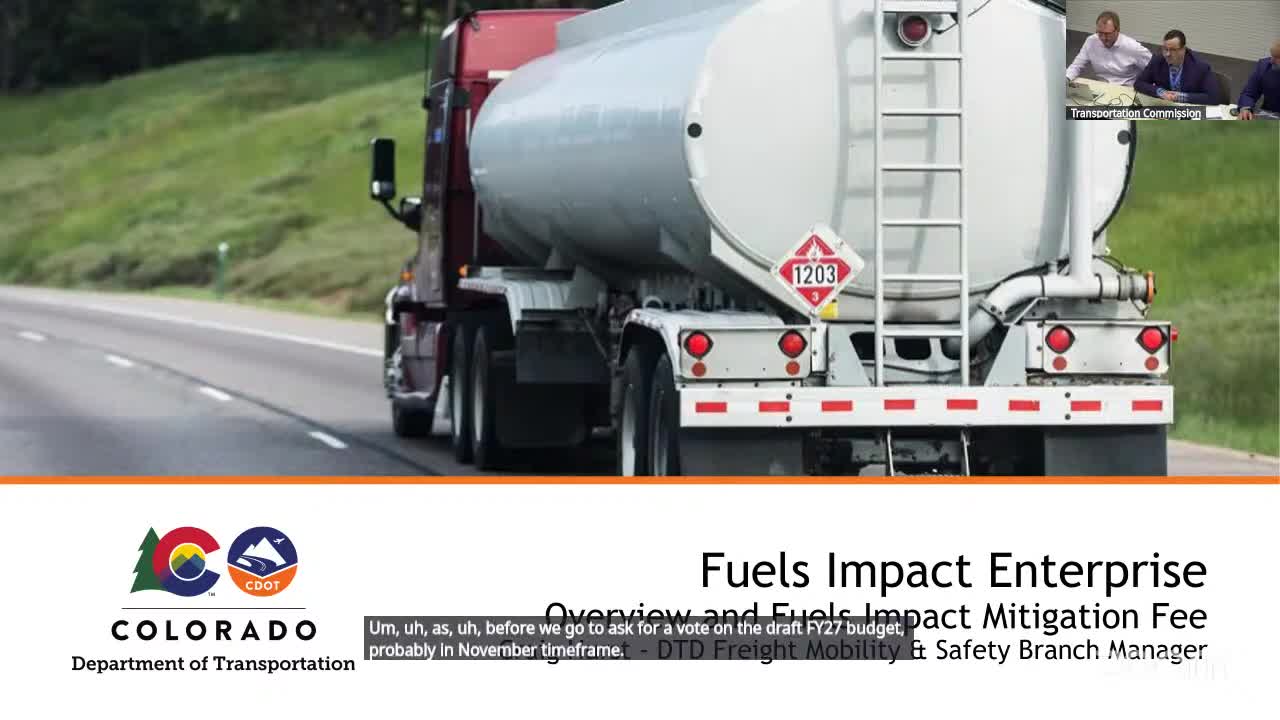
Summary
The Fuels Impact Enterprise told the Transportation Commission workshop that the state’s fuel‑impact fee yields about $15 million a year and that FY24–25 collections have already funded local distributions and state freight projects, with $11.46 million allocated for state projects this cycle.
The Fuels Impact Enterprise staff told the commission they have collected the statutory fuel‑impact reduction fee and distributed FY24 and FY25 funds to local governments and to the state project allocation program.
Background and fee structure: the enterprise was created by Senate Bill 23‑280 and the board set the maximum fuel impact reduction fee under statute; staff said that rate yields about $15,000,000 per year statewide. Under statute, $10,000,000 of the annual revenue is distributed to specific local governments (Adams County, City of Aurora, El Paso County, Mesa County and Otero County) pro rata by amount of fuel distributed at those locations; the remaining $5,000,000 is available to the state for freight‑related projects and other eligible activities.
What staff said they have done: Craig Hurst and Darius Pacbach explained that Colorado received an additional $1,460,000 of remaining FY24 revenue that the fuel enterprise board allocated in January 2025 to the state project allocation fund, bringing total state‑available funds to $11,460,000 for distribution. The enterprise has already approved $9.5 million of that pool to projects in Regions 1, 2 and 3, including a $7 million allocation for a Deer Trail I‑70 bridge package (Region 1) and roughly $1.25 million each for Regions 2 and 3 for surface treatment on freight routes.
Planned FY25 allocations: staff proposed distributing a remaining $1,726,000 of FY25 funds with $1,250,000 to Region 4 (surface treatments on freight routes) and $476,000 to Region 5, noting Region 5 has fewer eligible lane‑miles (no interstate) so the recommended allocation is smaller. Staff said they will bring a formal request to the boards for approval in November.
Why it matters: staff framed the money as targeted to freight‑route maintenance, hazard mitigation and emergency‑response projects and said the funds are limited to activities tied to the statute’s freight and hazardous‑materials objectives. Craig Hurst said the surface‑treatment projects in Regions 2 and 3 will likely produce roughly 15–20 miles of pavement treatment in each region.
Discussion and next steps: staff emphasized the legal constraint that local distributions must follow the statutory percentage of fuel distributed at the enumerated sites; they also said the state’s $5 million share must be used on federally eligible freight or emergency response projects or other statutory categories. The enterprise board will present the Region 4/5 allocation request at an upcoming meeting and continue coordinating with CDOT regions on freight‑route priorities.
Quotable: “The board of directors voted to allocate an additional $1,460,000 of remaining FY24 revenue to the state project allocation fund,” Craig Hurst said, summarizing the board’s January 2025 action.
No formal commission action was recorded at the workshop; the fuels enterprise board has authority to adopt allocations and will bring items to the CDOT commission or enterprise board for formal votes when required by statute and enterprise bylaws.