
Community board backs Seacoast Bank headquarters plan, recommends conditional-use approval to city commission
Get AI-powered insights, summaries, and transcripts
Sign Up Free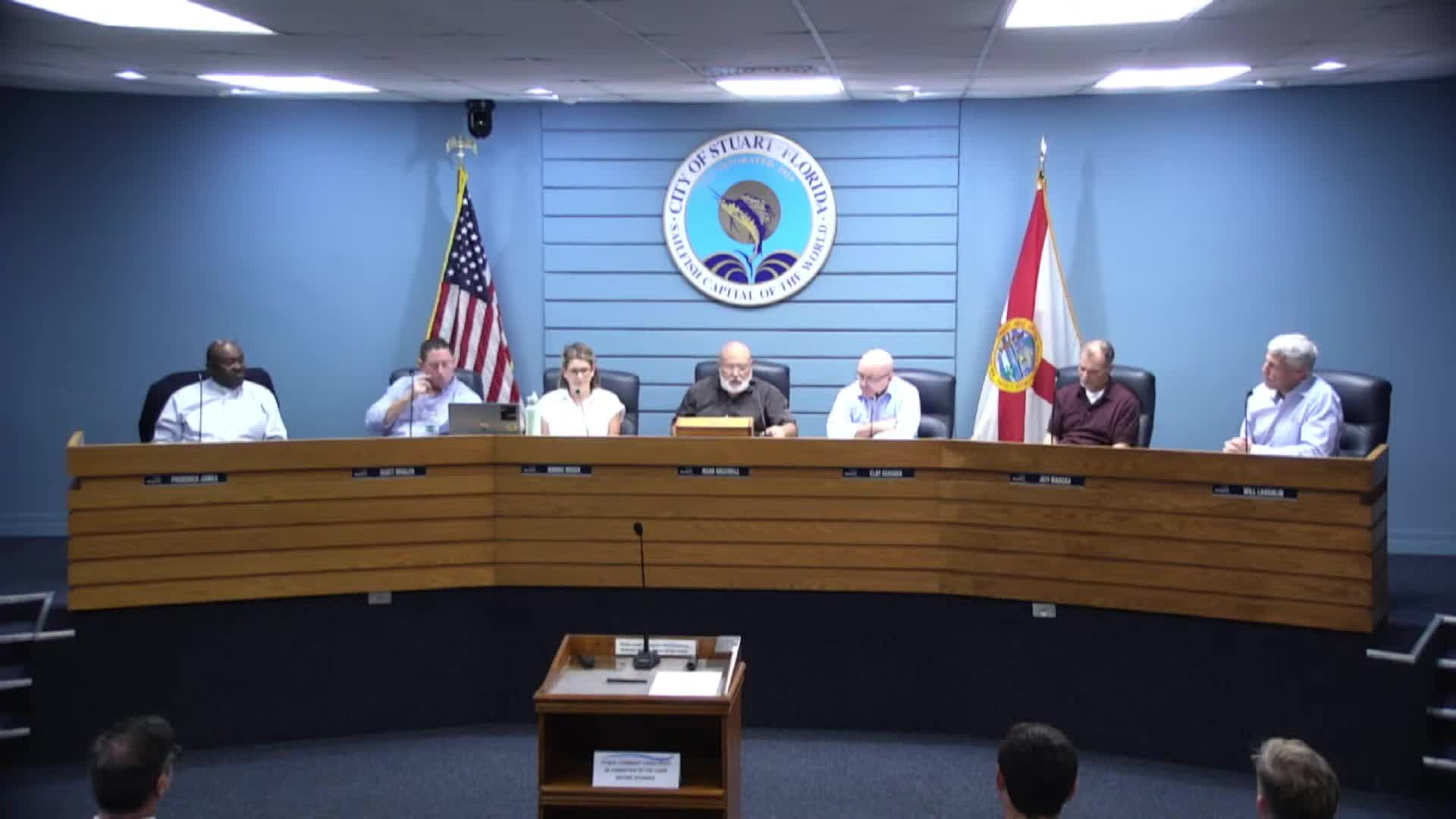
Summary
The Community Redevelopment Board recommended approval of Seacoast Bank’s plan to build a new three-story, 58,647-square-foot headquarters and a detached parking garage after staff said the redevelopment meets the Creek District form-based code with three requested design deviations.
Stuart’s Community Redevelopment Board voted unanimously on July 1, 2025, to recommend that the City Commission approve Seacoast Bank’s major conditional-use petition and major development plan for a new 58,647-square-foot, three-story headquarters and a detached private parking garage on the southeast corner of South Colorado Avenue and Kindred Street.
The plan, presented to the board by Jody Kugler, the city’s development director, seeks conditional-use approval for a detached private parking garage and three design deviations from the Creek District form‑based code: permitting the building’s primary entrance to face an interior plaza rather than US 1 or Colorado Avenue; allowing the existing 7‑foot sidewalks along US 1 and Colorado Avenue to remain instead of immediate replacement with 10‑foot sidewalks; and permitting a parking structure horizontal length of 246 feet, exceeding the 200‑foot maximum in the code.
Kugler told the board that the 8.13‑acre parcel is in the Creek South zoning district within the city’s community redevelopment area and that staff reviewed the major development plan under the city’s land development code and comprehensive plan. “Staff recommends the Community Redevelopment Board for a recommendation to the city commission for approval of the Seacoast Bank headquarters major conditional use and major development plan via resolution 85‑2025,” Kugler said.
Seacoast representatives described the project as an infill redevelopment that will keep the bank’s headquarters in downtown Stuart. Tracy Dexter, Seacoast Bank chief financial officer, said the bank’s Stuart campus currently houses about 225 employees and serves more than 5,000 local deposit customers at the branch on site. “Our vision really is to create a modern and dynamic campus that will continue to anchor our presence here for decades to come,” Dexter said, asking the board for its support.
Applicant team members said the redevelopment area is roughly four acres of the total site and that the design retains two existing office buildings during construction; one of those buildings will be demolished after the new headquarters opens so the detached parking garage can be built. The site plan calls for 268 parking spaces in total (including 7 handicap spaces), exceeding the Creek District requirement of 195 spaces for the proposed use; the garage would provide about 252 spaces. The bank building is shown at 44 feet (three stories) and the garage about 25.3 feet (three stories). The applicant also proposes additional pedestrian connections, landscaping that preserves an existing oak and a banyan tree, and on‑site stormwater and bioswale measures to reduce nutrient load to local waterways.
Engineers and public‑safety officials addressed concerns raised by board members and residents. Joe Capra of CapTek Engineering said the redevelopment will reconfigure a drainage area that currently tends to pond near the site and will route stormwater through a treatment train to Bruner Creek. Sheriff Stephen Budensick (identified in the record as Sheriff Budensik) and Stuart police representatives testified in support of the proposal’s security‑related deviation allowing the main entrance to face an interior plaza; Budensick said limiting direct access to US 1 improves the ability to monitor the site and reduce quick drive‑away robberies.
Members of the public who spoke during the hearing were mostly supportive. Duncan Hurd, a downtown property owner and former nonprofit leader, called the design “well thought out” and said the building could become a gateway to downtown. Several residents and business representatives urged the developer and city to prioritize larger shade trees and to coordinate with FDOT to remove utility obstructions that constrain the usable width of the existing sidewalks.
After questions and deliberation the board took a motion to recommend approval of the staff‑recommended resolution. The motion did not identify a mover or seconder in the public transcript; the roll call recorded unanimous support from board members present.
The Community Redevelopment Board’s recommendation goes next to the City Commission, which has final authority to adopt or deny the conditional use, the major development plan and the requested design deviations.