Get Full Government Meeting Transcripts, Videos, & Alerts Forever!
Spokane County outlines EIS alternatives for urban growth area, sets public outreach schedule
Summary
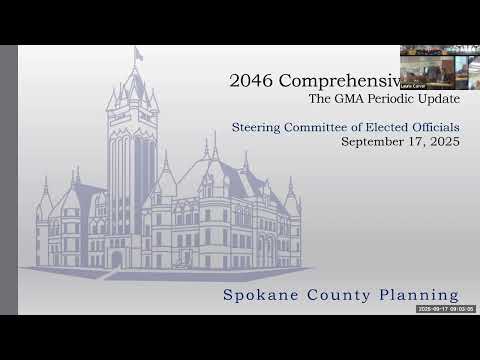
Spokane County staff on Sept. 17 previewed three Environmental Impact Statement alternatives for the county's periodic update to the comprehensive plan, saying the county will study options ranging from density-focused strategies to modest UGA boundary changes and will publish a draft EIS Dec. 1 with public outreach in October and December.
Spokane County staff told the county's steering committee on Sept. 17 that the county is preparing an Environmental Impact Statement to guide a periodic update of the comprehensive plan and to recommend how the county should accommodate projected growth over the next 20 years. "We are in the midst of working on alternatives for the EIS, and those alternatives are going to help guide the growth within the existing urban growth area boundaries as well as potential, adjustments to that UGA boundary," said Scott Chesney, county planning staff.
Why it matters: the county must show where it will accommodate projected new residents and how capital facilities, transportation and public services would be provided. The choice between adding land to the urban growth area (UGA) or planning for higher densities inside existing boundaries affects housing supply, farm and resource lands, water systems and fire and school capacity across Spokane County.
County staff described three bookend alternatives required for the EIS: a required "no growth" alternative for analysis; an alternative that keeps existing UGA boundaries and seeks large portions of the county's housing allocation through density and intensity changes; and an alternative that allows selective UGA boundary adjustments to preserve more of the county's historic single-family development patterns (roughly 4.5 to 5 units per acre) while permitting mixed-use, neighborhood-style development. Chesney said the county must be able to show how each option would accommodate roughly 100,000 new residents in the planning horizon and that, on the county side alone, accommodating that growth via density would account for an estimated 23,000 to 25,000 units.
Staff identified roughly 1,600 to 1,700 acres of land under consideration…
Already have an account? Log in
Subscribe to keep reading
Unlock the rest of this article — and every article on Citizen Portal.
- Unlimited articles
- AI-powered breakdowns of topics, speakers, decisions, and budgets
- Instant alerts when your location has a new meeting
- Follow topics and more locations
- 1,000 AI Insights / month, plus AI Chat