Get Full Government Meeting Transcripts, Videos, & Alerts Forever!
Get email alerts on the Fraud Risk Assessment topic
No spam. Unsubscribe anytime.
Consultants find no "oh-my-god" failures but flag permit overrides and student activity funds as higher risk
Summary
Auditors from CliftonLarsonAllen told the Board of Finance they found no critical fraud failures in town or school cash-handling but identified two higher-risk areas — permit fee overrides in the permitting system and the management of school student activity funds — and recommended stronger controls and periodic reviews.
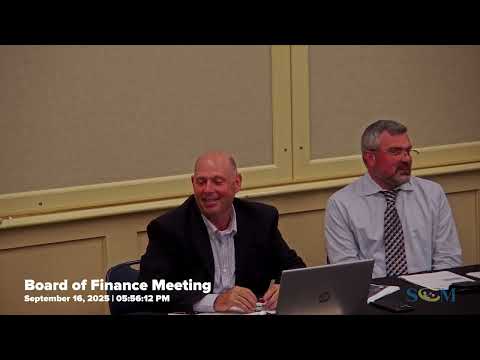
Consultants from CliftonLarsonAllen presented the results of a townwide fraud risk assessment of cash-handling on Sept. 16, telling the Board of Finance they found no critical control failures but identified specific areas that warrant stronger controls.
The consultants reviewed 11 cash-handling areas across town departments and Simsbury Public Schools, performed on-site walkthroughs and interviews, and evaluated documented policies and procedures. "There were no critical findings — I always call them 'oh-my-god moments' — there were none of those," said Jeff Ziplo, a principal at CliftonLarsonAllen. He said the review produced two higher‑risk items and a number of medium- and low‑risk findings the town could address to ``raise the bar'' on controls.
Why it matters: the assessment covers collections and cash-related functions where errors or abuse could move public dollars outside usual controls. The consultants and finance staff framed the work as proactive: the audit was commissioned not because of a known problem but to confirm controls and improve transparency.
Key findings and recommendations
- Permit fee overrides: The permitting system allows fee overrides (for instance, to avoid double-charging a subcontractor for a permit when the general contractor already paid). Aaron Perillo, a senior member of the CLA business risk services group, said those overrides are legitimate in some cases but currently lack a formal, documented review. The firm recommended either a system change to require a secondary review or a recurring report (monthly) that lists overrides for independent review and sign‑off.
- Student activity funds: CLA identified student activity funds (including athletics and class funds) as one of the higher‑risk areas because of the volume and timing of receipts. Consultants said teachers sometimes hold cash for months before turning it in, and some ticketed events (for example, prom or athletics) lacked routine reconciliation between ticket counts and receipts. Perillo advised clear policies on who may accept money, deadlines for deposit, reconciliation procedures that match receipts to sales, and secondary review of expenditures.
- Other weak points and routine recommendations: The consultants recommended formal deposit logs for departments that email or hand checks to finance (public works example); segregation of duties at point-of-sale locations with multiple cashiers sharing drawers; integration between credit-card processing and POS systems to reduce manual copying of card numbers; a townwide policy setting thresholds and timing for deposits (for example, daily or same-day deposits above a set dollar amount); and reconciliation between departmental systems and the finance office (myRec and Munis/Enterprise ERP).
- Technology and training: CLA suggested exploring integrations (for example, Municity or tax system interfaces into Munis/Enterprise ERP) to reduce manual journal entries and reduce risk, and pushing further user training for departments who reported not using available reports and screens.
Responses from town staff and board
Finance Director Amy (identified in the meeting as finance director) answered clarifying questions about current practices and confirmed that some audit recommendations have already been addressed by recent policy changes (for example, a tax‑check before issuing permits, which consultants noted had already been implemented). Town Manager Mark (referred to in the discussion) and board members asked about detection of schemes involving vendor changes, collusion, or employees creating vendors and issuing checks. CLA said the town has system controls and operational checks — vendor vetting, segregation of duties in Munis/Enterprise ERP, and bank reconciliations — that reduce risk and would make single‑actor fraud difficult. The consultants cautioned, however, that collusion between multiple employees is inherently difficult to detect.
Quantities and context
The engagement covered 11 department areas, including permitting/planning, public works, parks and recreation, tax collector, social services, police, board of education cafeteria and student activity funds, and IT-related petty cash (Chromebook insurance was a named example). On student activity funds the consultants and staff estimated cumulative balances in the low hundreds of thousands of dollars during the fiscal year (board discussion ranged from "I think I've got $100,000–200,000" to "about $300,000 with athletics"). CLA characterized most departmental issues as medium- or low‑risk control gaps rather than evidence of misuse.
Next steps and board direction
The consultants recommended specific, practical steps: require documented reviews of system overrides or run monthly override reports; adopt townwide thresholds and timing for deposits; standardize petty‑cash policies; reconcile departmental receipt systems with the finance system; and increase training and system integrations to reduce manual work and exposure. Finance staff and the board asked for an implementation timetable and updates; CLA and staff discussed following up with targeted remediation over the coming months. No formal board action was taken beyond discussion and requests for follow‑up.