Get Full Government Meeting Transcripts, Videos, & Alerts Forever!
Get email alerts on the External Audit topic
No spam. Unsubscribe anytime.
External auditors flag URS payroll process as material weakness; county accepts audit
Summary
Larson & Company issued an unmodified opinion on Tooele County’s 2024 financial statements but reported a material weakness in payroll reporting to Utah Retirement Systems (URS). The county council voted unanimously to accept the audit and auditors recommended per‑employee reconciliation with URS going back several years.
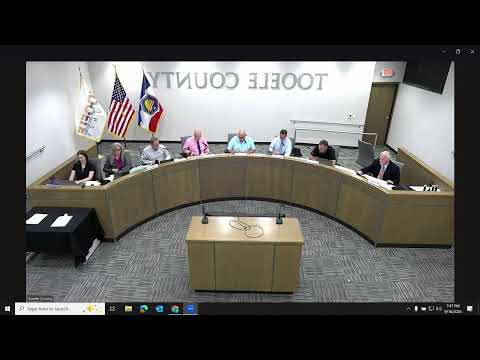
Tooele County accepted its 2024 external audit after Larson & Company presented an unmodified opinion on the county’s financial statements while identifying a material weakness tied to payroll reporting to the Utah Retirement Systems (URS). The council voted unanimously to accept the audit as presented. John Larson of Larson & Company, the lead auditor, told the council the financial statements received an unmodified opinion, meaning the auditors did not have to change their report because of unknown balances or untestable items. He said the audit also included a single‑auditor review of federal programs and a state compliance review that produced one state compliance finding and the material weakness on URS payroll. “So my expectation is this is taken care of next year. My hope by the end of 2025, this material weakness is gone,” John Larson said, referring to the county’s work to correct URS contribution reporting.
The nut of the auditors’ finding was that historical payroll contributions reported to URS contained errors. Larson recommended the county and its external auditors reconcile contributions at the individual‑employee level with URS records for the affected periods rather than relying solely on sample testing. He said that approach — comparing each employee’s gross pay and expected employer contributions to URS’s records — would identify which employees were over‑ or under‑contributed and produce a defensible net adjustment. Larson acknowledged that doing exhaustive per‑payroll reviews for several years would be costly and recommended starting with annual, per‑employee reconciliations and escalating only where discrepancies appear.
Larson also noted progress on prior findings: bank reconciliations are being performed, though not yet within the county’s financial reporting system; auditors prefer reconciliations inside the system for stronger internal control. The auditors reported one state compliance finding related to timeliness of deposits: state code requires deposits to be made within three days (with limited exceptions for remote locations), and auditors found a single instance where a deposit was delayed because the employee responsible was out sick for about seven days. Larson described that as a control weakness needing cross‑training or backup procedures.
County Auditor Allison McCoy and county manager Andy Welch participated in the discussion. McCoy acknowledged the difficulty the office has faced and thanked staff for their work to assemble records and support the audit. McCoy also described steps taken since the period covered by the audit and said the county is working with an external firm on URS reconciliation. Larson said he had discussed methodology with the outside firm and that sampling alone is insufficient once a known error exists; auditors must expand procedures to quantify the issue at the employee level.
At the end of the presentation, Councilman Wardle moved to accept the audit as presented; Councilman Stromberg seconded the motion. A voice vote was taken and the motion carried unanimously. The auditors said they will continue to follow up on the URS reconciliation and other control improvements in their next audit cycle.