Get Full Government Meeting Transcripts, Videos, & Alerts Forever!
Get email alerts on the Homelessness Supportive Housing topic
No spam. Unsubscribe anytime.
Dickinson commissioners deny United Way plan for Evergreen supportive-care center after lengthy public hearing
Summary
The Dickinson City Commission voted 3-2 to deny a special-use permit for the United Way Dickinsonproposal to convert the former Evergreen Building into a combined low-barrier shelter, treatment center and transitional housing. Supporters said the project fills gaps in local services; opponents cited safety, location and financial concerns.
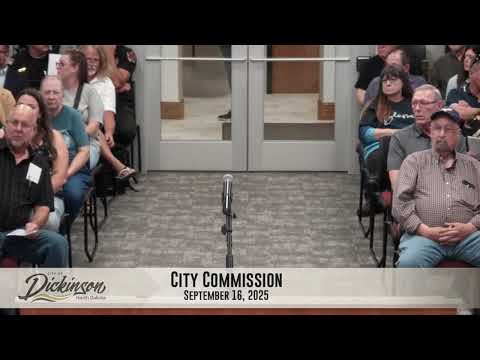
Dickinson, N.D. — The Dickinson City Commission on Sept. 16 denied a special-use permit request from United Way Dickinson to convert the former Evergreen Building into a combined low-barrier emergency shelter, treatment center and supportive/transitional housing facility, rejecting the proposal by a 3-2 vote. The motion to approve was made by Commissioner Riddle and seconded by Commissioner Murphy; Commissioners Riddle and Murphy voted aye, Commissioners Frederick and Bair voted no, and Chair Scott Decker cast the deciding no vote.
The proposal would have used three floors: a 13-room low-barrier emergency shelter on the first floor, an inpatient/outpatient treatment center on the second floor run by Southwest Multicounty Corrections Center (SWMCCC), and 30 supportive/transitional housing units on the third floor. United Way Executive Director Dakota Gant told commissioners, “This project is not simply a homeless shelter,” and that the facility is intended to "meet people where they are, stabilize them, and guide them into long term success.” He added, “Low barrier does not mean unsafe," and said the facility would exclude "high risk *** offenders or high risk violent offenders. That policy is non negotiable."
Why it mattered: Supporters said the facility would provide a continuum of care currently lacking in Dickinson — shelter beds, nearby treatment and transitional housing — and would reduce pressure on the county jail, emergency services and local shelters. Gant said startup funding has been identified, including a $1,000,000 HOME-ARP award, a potential Home Loan Bank of Des Moines award (described in materials as up to $3,500,000), and a $640,000 CHS implementation grant, and he projected that at capacity the facility could generate over $3,200,000 annually from Medicaid and other streams.
Supporters at the podium described personal experience with homelessness and recovery. Allison Wanner, clinical director at SWMCCC, urged evidence-based design and said research shows supportive housing can reduce recidivism and emergency costs. Melissa Banks, a resident, said transitional shelters helped her and her children. Jonathan Holt, state commissioner of recovery and reentry, appeared in support and said the governor—s office views such projects as a high priority.
Opponents raised safety, location and fiscal concerns. Neighbors and property owners stressed the Evergreen Buildings proximity to schools and residential units and argued the site could increase local emergency calls and depress property values. Trevor Ernst, a Dickinson resident, referenced a shooting outside a Bismarck shelter and said similar incidents underscore potential risks. Several speakers questioned the completeness of the projects business plan, the reliability of grant commitments, and staffing assumptions; Commissioners and members of the public pressed United Way on staffing levels, medical coverage and licensing requirements.
Operational details and constraints discussed on the record: Gant said the 13 emergency-shelter rooms are capped by grant rules and cannot expand. He described layered security, 24/7 trained security staff, controlled entry, cameras, and staff searches for safety concerns. The treatment floor, he said, would offer inpatient and outpatient services to reduce gaps in care. SWMCCC and United Way representatives said they had identified potential medical staffing partners and grants to fund initial staffing. City planner Natalie Burczyk told the commission that planning and zoning previously recommended denial (6-1) and that the city had received roughly 30 letters in the record, including both support and opposition, as well as a petition of approximately 400 signatures opposing the project.
The vote: Motion to approve the special-use permit was made by Commissioner Riddle, seconded by Commissioner Murphy. Votes: Riddle (yes), Murphy (yes), Frederick (no), Bair (no), Chair Scott Decker (no). The motion failed and the special-use permit was denied.
Next steps and context: United Way representatives said they would continue fundraising and said they were willing to provide quarterly reports in the first year if approved; the project relied on several identified grants but did not seek city tax funding. The commissions denial leaves the proposal paused at the local-permit level; the transcript contains no formal statement of an appeal or immediate refiled application.
The debate included repeated references to compliance and licensing rules for inpatient treatment beds and Medicaid reimbursement, the limits of local authority over operations funded or licensed by state programs, and the role of an advisory board United Way proposed for oversight. Commissioners emphasized local safety, fiscal risk, and the proximity of the site to schools and residences in explaining opposition. Supporters contended an operational, locally run facility would reduce downstream public costs and provide services currently unavailable in Dickinson.