Citizen Portal

Buckeye unveils airport master plan, outlines long-range runway and land-use vision

5865916 · September 17, 2025

Get AI-powered insights, summaries, and transcripts

Subscribe
AI-Generated Content: All content on this page was generated by AI to highlight key points from the meeting. For complete details and context, we recommend watching the full video. so we can fix them.

Summary

City of Buckeye aviation staff and consultants presented a draft Airport Master Plan and an associated long-range airport development vision at the Sept. 16 council workshop, outlining infrastructure needs, phasing and estimated costs for the next 20 years and beyond.

City of Buckeye aviation staff and consultants presented a draft Airport Master Plan and an associated long-range airport development vision at the Sept. 16 council workshop, outlining infrastructure needs, phasing and estimated costs for the next 20 years and beyond.

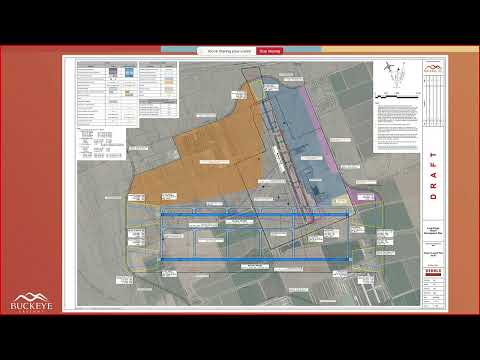
Scott Craig, Aviation Director for the City of Buckeye, described the Airport Master Plan as "a federal aviation required planning document" that sets a 20-year capital plan and supports eligibility for FAA and state funding. Craig and consultant Charlie McDermott (Dibble) walked the council through recommended airside and landside projects, a long-range development concept and next steps for adoption and FAA concurrence.

Why it matters: The plan maps out potential runway extensions, a new crosswind runway, taxiway and apron improvements, expanded hangar capacity and non-aviation development areas tied to regional economic growth. Staff emphasized the plan is intended to preserve options and to make Buckeye more competitive for aviation users, cargo and potentially commercial service in the long term.

Key recommendations and figures

- Runway and airside improvements: The plan retains the existing primary runway (designated 17/35) and identifies an initial 1,800-foot north extension to that runway, plus investigation of further extension northward to airport-owned property. The study also recommends adding a crosswind runway (designated 10/28) aligned east–west, initially scoped at 6,000 feet in some analyses and shown in a long-range conceptual layout up to 10,500 feet to support larger cargo and passenger aircraft in the longer term.

- Land-side development: Recommended improvements include additional apron and tie-down areas, new conventional and T-hangar development, maintenance and FBO facilities, relocated or reconfigured access roads (including a Yuma Road realignment to remove roadway from a runway protection zone), and non-aviation development areas along Palo Verde Road and near proposed freeway access points.

- Activity and cost outlook: Craig said Buckeye had roughly 122,000 operations last year and is on target for about 140,000 operations this year (the presentation also referenced a month with about 12,000 operations while closed for maintenance). The estimated 20-year capital cost in the plan is approximately $179 million, of which the study identified roughly $90 million as potentially eligible for FAA funding, nearly $7 million from the state, around $20 million local match and the remainder expected from private-sector investment for hangars and other non-grant-eligible projects.

- Phasing and FAA process: The plan groups projects into planning activity levels (PALs) rather than fixed years, allowing staff to slide projects forward or back based on demand. Craig said staff will finalize the Airport Layout Plan (ALP) and submit it to the FAA for review; that FAA review can take months, but the city will continue outreach and implementation activity while awaiting federal concurrence.

Council feedback and next steps

Council members asked about timeline, community outreach and coordination with military users. Craig said the project team completed multiple Planning Advisory Committee meetings and two public information meetings; he said he had coordinated an airspace and instrument-procedure analysis with aerial-navigation experts to minimize impacts on Luke Air Force Base operations. Craig said that the airport-specific area plan (a land-use and zoning study required to ensure compatible uses around the airport) is out for consultant selection and will be led by the city's Development Services team.

Craig summarized next steps as finalizing the master plan, completing the ALP, presenting the completed study to council for adoption (targeting a November meeting), submitting the ALP to the FAA for concurrence, and starting the airport-specific area plan and related zoning/overlay updates.

Ending

No formal council vote occurred at the workshop. Craig said the city will act on the plan as adopted by council and continue to seek FAA funding and partnerships for design and construction phases; council members urged staff to publicize the plan broadly to attract potential aviation, cargo and commercial users and to protect airport-adjacent land through the forthcoming area plan.