Get Full Government Meeting Transcripts, Videos, & Alerts Forever!
Get email alerts on the Esol Ells topic
No spam. Unsubscribe anytime.
Seminole County highlights ESOL gains, incoming-student supports at Hispanic Heritage kickoff
Summary
District ESOL staff and students presented outcomes and supports for English learners, including exit and screening counts, dual-language offerings and tools planned for newcomers.
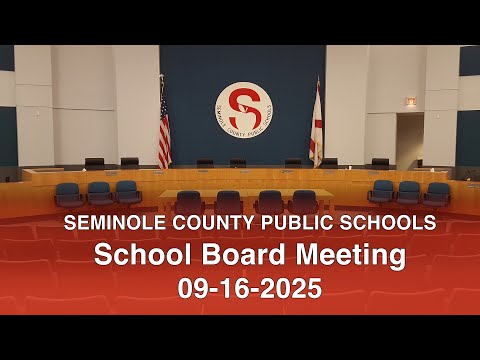
Seminole County Public Schools outlined results and supports for English learners during a Sept. 16 school board meeting presentation that kicked off the districtHispanic Heritage Month celebrations.
The presentation, led by ESOL curriculum specialist Vanessa Brewster, reported that the district has exited 667 students from ESOL services this year after they met state exit criteria and has screened more than 1,500 new students for the program. "We represent 132 different countries in our district," Brewster said, adding that the district continues to monitor exited students for two years.
Why it matters: The report summarized how the district is scaling supports for newcomers and for large multilingual student populations, including targeted summer programs, sheltered instruction at the secondary level and dual-language programs in nine schools. Board members asked about classroom devices and asked staff to keep them apprised of in-person visits and community events.
Key facts - ESOL exits reported: 667 students who met state exit criteria (WIDA ACCESS and FAST benchmark levels). - New-student screenings: "over 1,500" and screening was ongoing at the time of the presentation. - Active ESOL caseload reported: 3,665 students (district figure reported during the presentation). - Students monitored after exit: 1,224 students tracked for two years, per the presentation. - Dual-language schools: staff reported nine district dual-language schools.
Program model and supports Brewster and ESOL staff described two district models: an elementary ‘‘push-in’’ inclusion model where ESOL-endorsed teachers push into classrooms during ELA blocks, and a secondary sheltered-English model in which endorsed teachers deliver grade-level content scaffolded by language strategies. Brewster said sheltered instruction is used for students earlier in language acquisition and that the program integrates listening, speaking, reading and writing across content areas.
Summer and newcomer services District staff described a summer "newcomers" program that included parent classes using Reading Horizons, take-home tablets for families, field trips (including to the Orlando Science Center) and small-group math/science/literacy interventions. Staff said the program uses online tools (Achieve3000, Khan Academy, Quill) and a practice resource called the Finish Line Book to prepare students for the WIDA ACCESS language assessment and state tests such as FAST and college-admission exams.
Technology and translation supports Board members asked about devices and translation tools. Brewster said the district will purchase a low-cost "pocket talk" device to supplement existing language-live devices and district laptops and tablets used to bridge native language and English.
Voices from the meeting Student Omaris Gabriela Valentin Sanabrio, a Lake Brantley High School senior and Latinos in Action president, described taking multiple AP courses and invited board members to school Hispanic Heritage events. Brewster credited ESOL teachers and said, "In Seminole County, we had 31 percent of our English language learners achieve language proficiency. The state average was 15 percent."
What didnnext: Staff said screening was continuing and that the district would continue monitoring exited students and implementing action plans for cohorts (for example, targeted supports for current third graders). Board members asked to be invited to school events and to see device rollouts in classrooms.