Get Full Government Meeting Transcripts, Videos, & Alerts Forever!
Get email alerts on the Behavioral Health Coresponse topic
No spam. Unsubscribe anytime.
Council committee approves grant for police–clinician co‑response; officials detail call volume and staffing questions
Summary
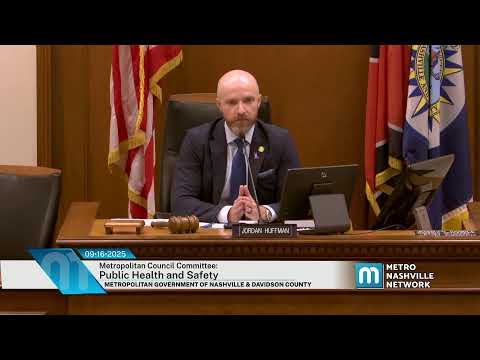
The Metropolitan Council's Public Health and Safety Committee on Sept. 16 approved a grant contract with the Mental Health Cooperative to fund emergency psychiatric care and support Nashville's police‑clinician co‑response program.
The Metropolitan Council's Public Health and Safety Committee on Sept. 16 approved a grant contract with the Mental Health Cooperative to fund emergency psychiatric care and support the Nashville Police Department's co‑response program, Nashville Partners in Care. Council members asked for follow‑up information on staffing, dispatch criteria and whether the program is fully funded.
Committee members said the program diverts people in crisis from the criminal justice system while providing clinical support on scene. The grant resolution (RS2025-1489) passed on a committee vote.
The Mental Health Cooperative and Metro Police Department described how the co‑response model operates. "Since its inception, partners and cares responded over 58,000 calls for service," Chris Gilder of the Metro Police Department said at the meeting. He said the partnership has responded to more than 11,000 calls exclusively involving someone in a mental‑health crisis and that "a little over 4 percent of those calls have resulted in arrests." He added that roughly 600 officers and supervisors have completed the 40‑hour crisis intervention team (CIT) training.
Council members pressed for details about how calls are routed. Gilder said the Department of Emergency Communications (DEC) uses dispatch criteria to decide when to send a co‑response car; if a co‑response unit is on duty and meets criteria it will be dispatched. He said officers on scene can also request a co‑response unit when they determine a mental‑health issue is present. "Sometimes... it becomes evident later on that this person is someone who's in a mental health crisis," he said, describing both DEC dispatch and officer‑initiated requests.
Officials said co‑response cars are assigned across multiple shifts but not necessarily staffed 24 hours a day; officers work 10.5‑hour shifts and staffing gaps can occur overnight. Council members requested follow‑up from DEC on the specific dispatch criteria used at the 9‑1‑1 center and asked the Metro Police Department for data on how many co‑response cars are available per shift.
Several council members praised the program's results and asked whether the new grant will make the program fully funded. Metro officials said they would follow up with funding and staffing specifics and noted that Mental Health Cooperative representatives were not present to speak to the budget allocation.
Ending: Committee members approved the grant and asked staff to provide the committee with: (1) DEC dispatch criteria for co‑response calls; (2) the number of co‑response cars by shift; and (3) a funding status update showing whether the program is fully funded or will need additional resources going forward. No formal amendments or conditions were recorded in committee beyond requests for follow up.