Get Full Government Meeting Transcripts, Videos, & Alerts Forever!
Get email alerts on the Stormwater Flooding topic
No spam. Unsubscribe anytime.
Port Orange council, staff and residents press for short‑term stormwater fixes while pursuing long‑term projects
Summary
In a lengthy public session and staff briefing, Port Orange officials described system limits after a heavy September rain event, outlined progress on regional funding and infrastructure projects, and heard residents press for short-term measures to protect homes in Beacon Woods and other low‑lying neighborhoods.
City officials in Port Orange presented details of an intense mid‑September rain event and outlined both near‑term actions and longer-term projects aimed at reducing localized flooding, while residents urged the council to pursue immediate mitigation for neighborhoods that have flooded repeatedly.
City briefing and technical overview: City Manager Junor Reed and engineering staff said the city received a concentrated three‑day rainfall with a particularly intense period Sunday night that delivered about 4 inches in roughly an hour in parts of Port Orange. Reed noted the event coincided with on‑shore winds and a king tide, creating a worst‑case combination for a gravity‑based drainage system. "It also coincided with onshore winds, the beginning of what was a king tide, a full moon high tide. Worst case scenario for how our drainage system is structured," Reed said.
Staff emphasized that Port Orange’s stormwater system consists of a mix of open ditches, pipes and pump stations and that much of the system is gravity‑driven; if outfalls are blocked by high tides the system backs up. The city highlighted maintenance gains — faster ditch cleaning and additional equipment — and work to accelerate projects, including several shovel‑ready designs and pending grant awards. Reed and the city engineer said the long‑term strategy includes adding pump capacity to overcome tide constraints and pursuing multiple state and federal funding sources, including Transform 386 and Resilient Florida grants.
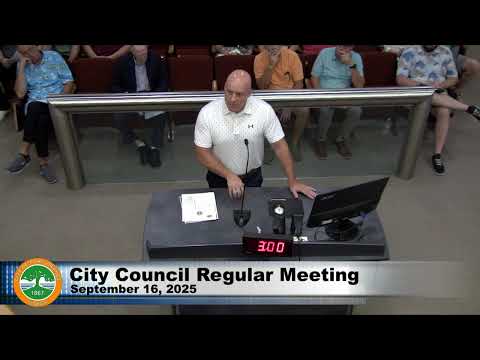
Public concerns and specific bottlenecks: Many residents described repeated damage and urged short‑term measures. Jim Duke of Beacon Woods said residents need an interim plan: "We need a short term plan that's gonna take us through this season and next season because nothing that's going on now is gonna do anything for the next 2 years," Duke said. Resident Matthew Bondress noted that work on Jackson and Oak Streets — intended to pipe tight ditches and improve conveyance — has been delayed by utility conflicts; city engineer Junor Reed said Florida Power & Light’s delay moving poles has kept the contractor off site and added about eight weeks of work after FPL completes pole relocations.
On Jackson and Oak Street work: Junor Reed said the project is not meant to add storage but to improve conveyance and maintainability. Because the project paused when power poles blocked the trenches, temporary plywood blanks were installed at inlets to prevent silt entry; staff said those blanks were removed before the last storm so the system could flow and that the contractor will clean accumulated sand and debris once the project resumes. "We instructed our contractor to go out there, and we pulled all those piece of plywood blanks out of there so that the system would flow more freely," Reed said.
Cambridge pump station and system limits: Council members and staff described the Cambridge Basin pumps operating during the storm. Officials said the rate and concentration of rainfall overwhelmed conveyance before pumps and ponds could fully respond: "We had so much rain that fell in the collection system, the…funnel…that it overwhelmed the collection system before that water even got to the pond," a council member observed, summarizing staff comments.
Funding and regional coordination: City staff described progress on a stormwater master plan, vulnerability assessment and multiple funded or pending projects that together aim to address principal bottlenecks. Reed said Port Orange secured approximately $4.4 million in state funding this year and has projects in Transform 386 funding queues totaling roughly $22 million; county efforts are also studying the larger Nova Canal system that affects Port Orange outfalls. Council members encouraged residents to contact county and state representatives to support release and awarding of regional funds.
Resident testimony: Several Beacon Woods homeowners described repeated impacts and personal loss. Raya Young recounted being a single mother whose house flooded twice in five years and told the council flood damage had "shattered" plans to keep her family together: "No insurance can ever cover is the lasting toll, the pain, the suffering, the gnawing anxiety that becomes a constant companion," she said. Other speakers, including Reverend Carrie Niedermeier and Shirley Rice, offered to host neighborhood meetings and recommended examining model approaches used in other countries for resilience.
Short‑term remedies considered: Residents and some council members asked whether portable pumps, temporary retention or selective property acquisition could be deployed for the next season. Staff said some options are limited — many retention ponds and canals are permitted for specific capacities and cannot be legally pumped higher — but committed to exploring tactical measures where feasible and to continuing door‑to‑door outreach. The city also plans to press for faster regional coordination on the Nova Canal and other jurisdictional assets.
What happens next: Staff said they will continue outreach to residents, refine short‑term mitigation options, and advance design and permitting for funded projects. Several council members asked staff to present concept sketches and timelines for neighborhood‑level actions when available. The council also approved a letter supporting county efforts to refine state legislation (SB/SP 180) that the county says preempted some local rules; that vote was 5‑0.
Ending: The council framed the problem as both technical (drainage design and tide constraints) and political (regional funding and interagency permits). Residents said they appreciated staff responsiveness but pressed for tangible, near‑term relief for neighborhoods that have flooded repeatedly.