
Jones County leaders discuss zoning amendment to guide data center projects
Get AI-powered insights, summaries, and transcripts
Subscribe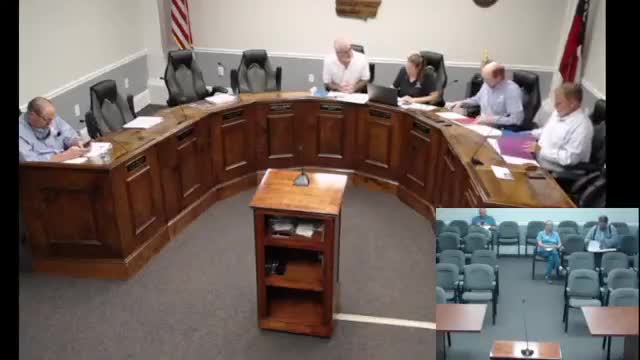
Summary
At a Sept. 16 work session, Jones County officials and planning staff reviewed proposed amendments to the county's Comprehensive Land Development Resolution that would set environmental-review, noise and infrastructure standards for data centers. No ordinance was adopted; staff will present a final draft at the regular meeting.
Jones County officials and planning staff met in a Sept. 16 work session to review proposed amendments to the county's Comprehensive Land Development Resolution intended to establish review standards for data center proposals, including when and what type of environmental study would be required, noise limits and utility infrastructure expectations.
The discussion centered on competing draft language for Section 96.19 of the county's development code. County staff presented three versions of the proposed text: an initial staff draft, a version revised after industry (developers/operators) comments, and a subsequently reworded staff version. Staff said the Planning Commission recommended approval of the amendment but had not seen the final staff revision that incorporated developer and later staff edits.
Why it matters: Data centers can require large amounts of power and water, build transmission lines, and create both construction- and operations-period noise and traffic impacts. The county does not have a pending data center application, but the amendment is intended to give Jones County standards to evaluate any future proposals.
Board members and planning staff debated how prescriptive the county should be at the application stage. Some members said they wanted a clear requirement for environmental review to capture potential impacts to aquifers, protected species and archaeological resources; others favored a narrower, staged approach that would require only a baseline report initially and reserve the county's right to require more detailed, site-specific studies later.
Tim, a county staff member leading the review, described the development of the draft language and said the Planning Commission had recommended approval with staff comments included. He explained that the original formulation used the phrase "environmental impact study," which could require expensive, comprehensive reports at the application stage; staff revised that language to reduce upfront cost and allow targeted studies when warranted.
"We had the proposed text amendment, went through the planning commission," Tim said, summarizing the process and the three draft versions provided to the board.
Erlene Hamilton, a member of the Planning and Zoning Commission who also visited a nearby facility, cautioned that utility infrastructure to serve a data center often requires new high-voltage lines and substations that can affect properties beyond the project site. "It's a really big facility," Hamilton said of the Social Circle site she visited, noting that transmission-line routing and potential property takings can affect owners away from the data center footprint.
Board members discussed several substantive provisions and operational concerns raised in the packet and by site visits to other facilities:
- Environmental review: The drafts differed on scope and timing. One early draft would have required broad, up-front studies (staff's initial text used the term "environmental impact study"); later versions favored an initial environmental-impact report that must "at a minimum" address topics such as energy use/generation, air quality and water, while reserving the county's right to require additional studies where site-specific conditions indicate potential impacts. Several members said the final staff wording, which keeps that reservation of county discretion, strikes the right balance between protection and cost.
- Noise standards: The group discussed daytime and nighttime decibel thresholds and reached informal agreement on a baseline of 45 A-weighted decibels (dB(A)) daytime and 35 dB(A) nighttime at the property line as a starting point for conditions triggered by a proposal. Board members noted that ambient rural sound levels vary and that a study should measure existing ambient sound to determine actual impact.
- Power and transmission: Commissioners and planning staff flagged power demand and transmission routing as major concerns. Several speakers described visits to other sites (Social Circle, Fayetteville, Meta facilities) and relayed that new transmission corridors and substations could require easements or condemnations beyond the project parcel. Staff and commissioners emphasized that any county infrastructure upgrades (power, water, fire/EMS equipment) required to serve a facility should be the developer's responsibility, not the county's taxpayers.
- Water and cooling systems: Board members discussed closed-loop cooling, on-site water storage/reservoirs and minimizing demand on municipal systems. Staff noted closed-loop options and on-site reservoirs can reduce strain on local utilities.
- Location: Participants said data centers in an existing industrial park, where prior site-wide studies already exist, should have lighter additional requirements than proposals on previously undeveloped parcels near residences or sensitive resources.
Board members also addressed public confusion: multiple speakers said social media had circulated reports claiming a data center was already approved for Jones County; they clarified there is no application and that the work session was to set rules for evaluating any future proposals. Tim confirmed he would brief the board again at the county's regular meeting that evening.
No zoning ordinance or amendment was adopted during the work session. The work session produced direction to keep the county's ability to require additional, site-specific studies where warranted, to use measured ambient sound levels when applying a 45/35 dB(A) guideline, and to require developers to bear the cost of infrastructure needed to serve a facility. Staff will return with a final draft for the formal meeting process.
Votes at a glance
- Motion to adjourn the work session: passed. The transcript records a motion and a second and the board chair calling for "all in favor, Aye," after which the meeting ended.
Ending
County staff and Planning and Zoning members said they will continue revising the draft amendment and provide public-facing information to clarify that no data center has been approved and that the code changes are to guide evaluation of potential future proposals. Tim said he would be present to brief the full board at the 6 p.m. meeting.