
Board renews Lookout Mountain short‑term rental but caps nighttime occupancy at 14
Get AI-powered insights, summaries, and transcripts
Subscribe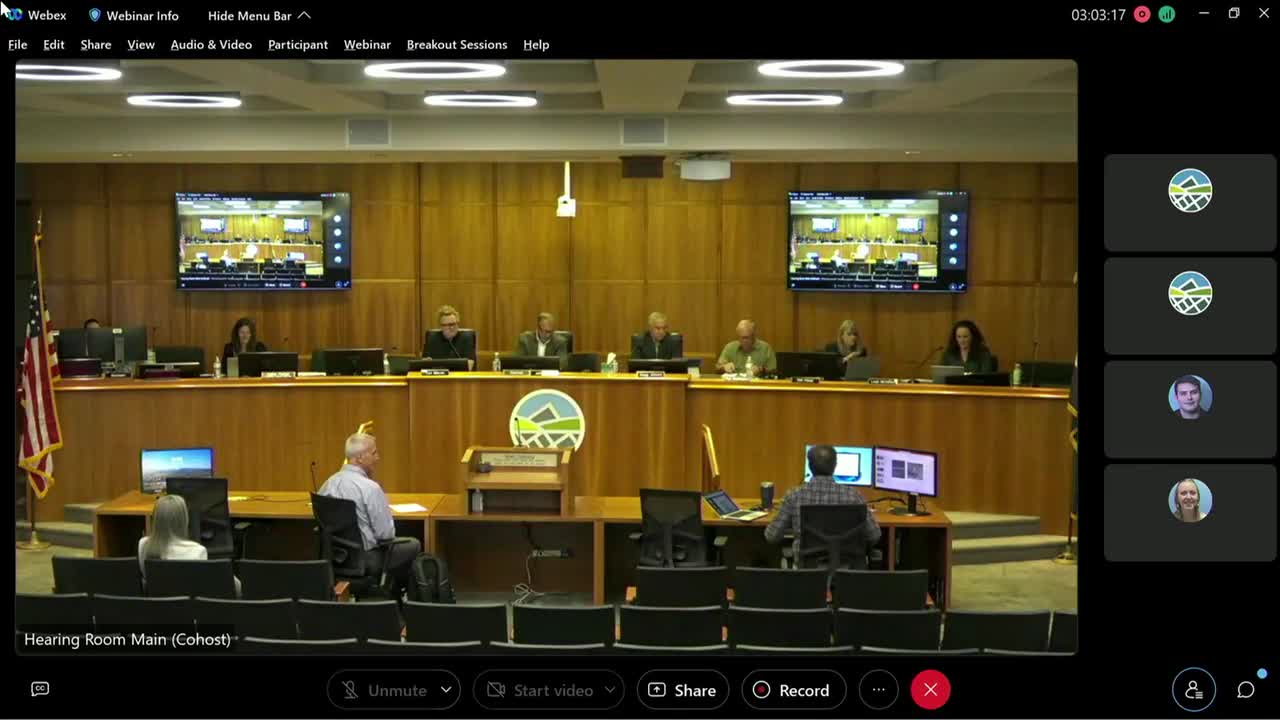
Summary
After weeks of review and testimony about the property’s long history as a picnic/recreation site, the Jefferson County Board of Adjustment renewed the short‑term rental permit for 97 South Lookout Mountain Road with a nighttime occupancy cap of 14 and a daytime limit of 50; the applicant had sought an increase to 21.
The Jefferson County Board of Adjustment on Sept. 17 approved a renewal of the short‑term rental permit for the property at 97 South Lookout Mountain Road, imposing a nighttime occupancy limit of 14 and a daytime cap of 50 people. The applicant had sought permission to increase the permitted occupancy to 21; staff and several board members expressed concern that 21 would be inconsistent with neighborhood scale and could read as a commercial use.
Alex Folkes, the case manager, told the board the application was the seventh renewal of a permit first approved in 2017. The property sits in a planned development (PD) that allows single‑family residential uses and also lists picnic and recreational facility uses in its original plan. Folkes said the applicant requested an occupancy of 21 people; staff reviewed short‑term‑rental criteria and recommended denying the 21‑person occupancy while noting the site had a complex history. Public Health (Mitch Brown) reviewed monitoring reports and told staff the septic system could support 21 people, Folkes said, but staff remained concerned about compatibility and community character at that scale.
Applicant John Hermanussen, who identified himself as a co‑host managing the property with a family member, described the site’s long history as a picnic and recreation area — a use that predated much of the surrounding residential development. Hermanussen told the board the property has historically hosted large gatherings and that onsite facilities include a recreation barn, picnic tables, and parking for roughly 73 cars; he said the septic system had been upgraded and that, in his view, the property could physically accommodate higher overnight occupancy.
Staff noted differences between bedrooms and “sleeping areas.” The assessor listed four bedrooms while the case materials identified seven sleeping rooms; Folkes explained the county’s usual practical limit is two occupants per bedroom, and recent board practice and zoning guidance had moved toward more conservative occupancy limits to preserve neighborhood character. The public‑health review that Folkes cited concluded the septic system could handle 21 people, but staff recommended approval only at a lower occupancy (14) and described other conditions including bear‑proof trash receptacles and adherence to the county’s defensible‑space requirement.
Hermanussen described multiple mitigation steps he and his co‑hosts use: designated parking with cones to discourage on‑street parking, multiple security cameras and noise monitors, a “party squasher” device that registers on‑site Wi‑Fi device counts, a local presence when groups are in residence, and rules that allow managers to evict guests who violate restrictions and to retain security deposits as liquidated damages. He said much of the site’s patronage comes from family groups and wedding‑party gatherings at nearby venues; he said they avoid marketing to younger groups and that larger wedding crowds generally exceed the property’s limits.
Board members debated whether allowing 21 overnight guests would be comparable to allowable single‑family residential uses or would amount to a commercial lodging/assembly use inconsistent with the PD and with nearby residential lots. Several members said 21 people would exceed the scale of a residential property in the area and risk becoming effectively commercial; others noted the property’s long historical use for public recreation and the existence of a larger onsite recreation area.
Ms. Porter moved approval of a special exception renewing the short‑term rental but with a nighttime occupancy limit of 14 and a daytime limit of 50 as recommended by staff. The motion passed on a roll call vote: all five board members present voted aye. The board attached the staff‑recommended conditions and the occupancy limits to the approval. Staff advised the applicant to coordinate with the case manager on next steps and on implementing the specified conditions.