
Speakers press for Tijuana River restoration and state funding as council hears updates
Get AI-powered insights, summaries, and transcripts
Subscribe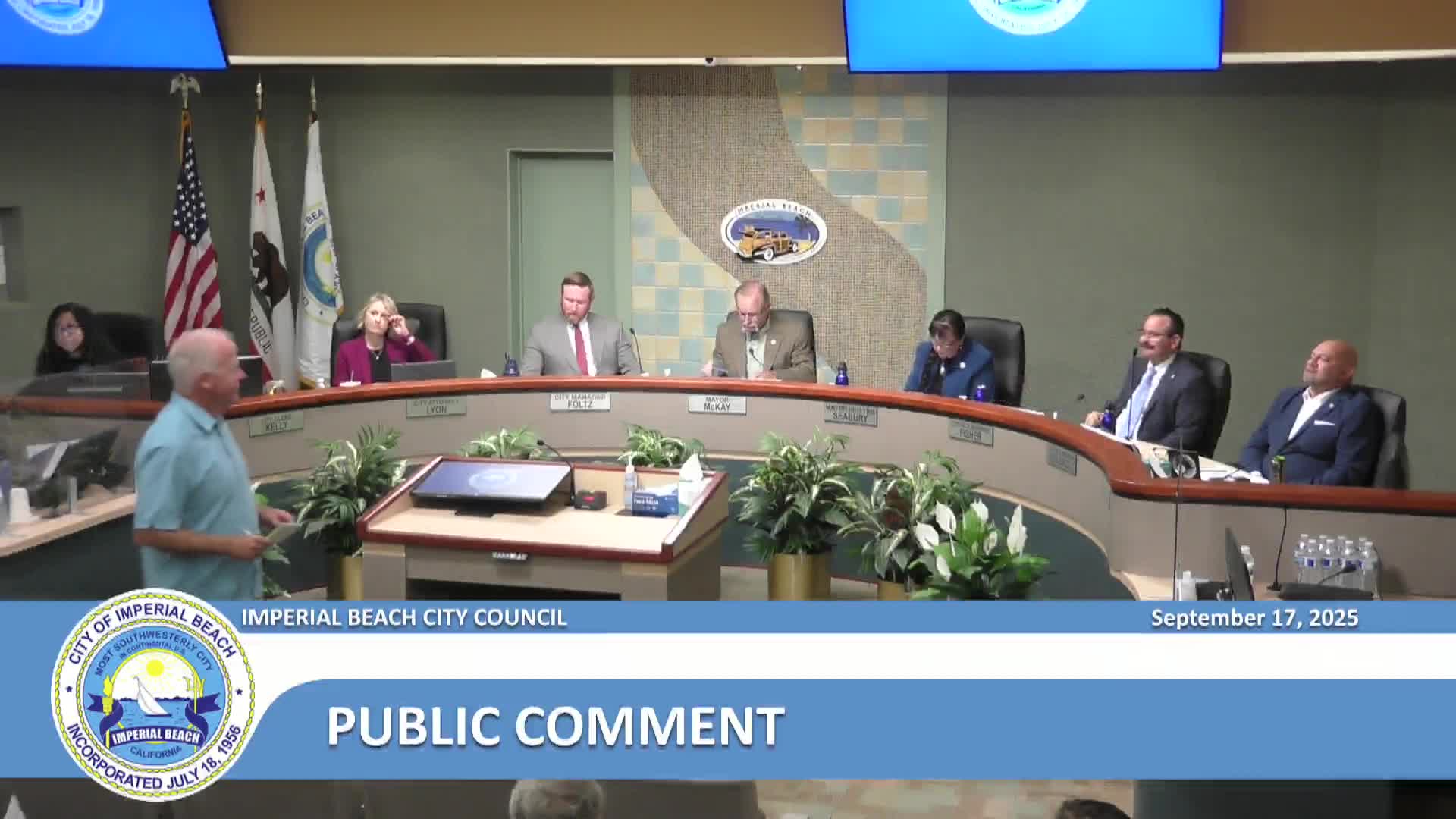
Summary
Multiple speakers at the Sept. 17 Imperial Beach council meeting urged state action and funding to restore the Tijuana River and recover sand for local beaches; former mayor’s advocacy to state agencies and public estimates of sand volumes were cited.
Several speakers at the Imperial Beach City Council meeting on Sept. 17 urged the city and state officials to press for restoration funding for the Tijuana River Valley and to prioritize recovery of sand that can replenish local beaches.
Leon Benham, who spoke during public comment, said former Mayor Paloma Geary had recently “gone in front of the state water, resources board just to advocate for about a $50,000,000 fund to restore the Tijuana River.” Benham told the council his calculations showed the river supplies the city with “655,000 cubic yards of sand every year on average,” and that sand moving down the river is protected under California law, a point he urged the council to press.
Council members and public speakers also discussed larger regional dredging options. Mayor Pro Tem Seaberry summarized a SANDAG shoreline preservation briefing she attended, noting the high cost and logistical limits of buying a large hopper or hydraulic dredger for West Coast work. “To purchase 1 of these dredgers is a $100,000,000… and it’s so costly because… they have to comply with the Jones Act that it must be built in the United States,” Seaberry said, citing information shared at the working group.
Speakers contrasted the cost of artificial sand placement with the natural replenishment that can occur when the Tijuana River is functioning: Seaberry said, “we paid last time $11,700,000 for only 450 cubic yards,” and argued restoring river function could deliver more sand for less cost. Leon Benham added that natural sand transport also helps “scour” the river bottom and reduces the ponds of sewage that cause nightly odors.
Public commenters asked the council to support legal and funding efforts at the state level; Truth and others cited the city’s existing Resolution 2025-20 prioritizing federal and state action to address cross-border pollution. The council did not take new formal action on the river at the Sept. 17 meeting; discussion and advocacy from city leaders and former officials was described by speakers as ongoing.
Speakers and council members repeatedly framed the river problem as multi-jurisdictional — involving the International Boundary and Water Commission (IBWC), state agencies and federal partners — and therefore requiring state and federal engagement as well as local advocacy.