Buckeye presents airport master plan recommending new crosswind runway and long-range development
Loading...
Summary
City of Buckeye aviation staff and consultants presented a federal-compliant airport master plan and long-range development recommendations at the Sept. 16 council workshop, including runway and landside expansions.
City of Buckeye aviation staff and consultants presented an airport master plan and an appended long-range airport development plan at the Sept. 16 council workshop, showing staged airside and landside projects the city says would make the airport eligible for federal funding and support future commercial, cargo and military activity.
Scott Gray, the city’s Aviation Director, told council the master plan follows Federal Aviation Administration guidance and outlines a 20-year capital plan and the airport layout plan that supports eligibility for FAA and state grants. “The purpose is to identify projects that are eligible for federal funds,” Gray said.
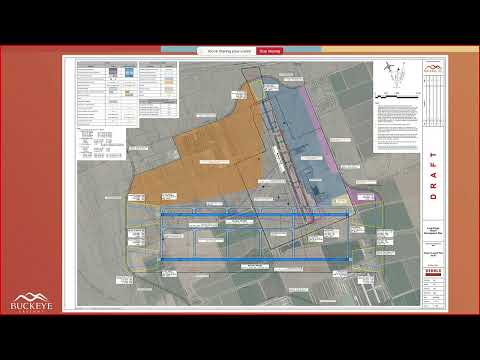
The draft airport layout plan included these principal recommendations and findings:
- Runway and airside changes: The existing primary runway (Runway 17/35) would remain and is shown with a northward extension of about 1,800 feet in the plan; the study also identifies an east–west crosswind runway, Runway 10/28, with an initial planning length identified at 6,000 feet and longer options (up to 10,500 feet) included in the long-range vision to accommodate cargo, commercial and larger military aircraft.
- Air traffic control and instrument procedures: The plan recommends adding an air traffic control tower and installing instrument approach procedures to improve reliability in lower-visibility conditions; Gray said the FAA has flight-checked the approach procedures and publication is anticipated in the months ahead.
- Phasing and costs: The 20-year capital cost estimate presented was approximately $179 million; Gray said nearly $90 million of that was identified for potential FAA funding, about $7 million for state funding and roughly $20 million of local match or local projects, with remaining costs expected to be privately funded (for example, private hangars). He noted FAA funding for large projects is typically phased and competitive, and projects commonly proceed in pieces (design, grading, construction) over several funding cycles.
- Operations and demand: Gray reported increased activity at the airport: “We had 12,000 operations last month and we were closed for a week,” he said, and staff projected about 140,000 operations for the year, up from roughly 122,000 the previous year. Consultants and staff also incorporated an airspace and instrument procedures analysis intended to minimize impacts on Luke Air Force Base operations.
- Land-use and area planning: The plan includes non-aviation and aviation development areas, proposed access connections to I‑10, and a recommendation for an airport-specific area plan to establish compatible land use, height and noise overlays near the airport. Gray said the airport-specific area plan work will be led by development services and is required by FAA/state guidance to control land uses around airports.
Council members asked about sequencing, economic impact analysis and stakeholder engagement. Gray said the city has formed a 18-member planning advisory committee including FAA and ADOT representatives, military liaisons, tenant representatives and trade groups; the study also featured two public information meetings with roughly 30–40 attendees each. Gray said the city will submit the airport layout plan to the FAA for adoption after final edits and expects to return to council to adopt the study formally later in the fall.
Council discussion emphasized the long-range vision’s value in attracting users and protecting property for future airport-compatible development. Several members urged staff to publicize the plan to prospective cargo, passenger and corporate operators and to use the airport-specific area plan to protect lands the city hopes to reserve for aviation uses. Gray said many projects in the plan are carryovers from a 2007 master plan and that cost escalations and process time explain the multi-year phasing.
No votes were taken at the workshop; staff said they will finalize documents, pursue next steps with FAA review and begin the airport-specific area plan selection process.