
Rockport‑Fulton unveils district comprehensive counseling model, expands virtual and on‑campus mental‑health supports
Get AI-powered insights, summaries, and transcripts
Subscribe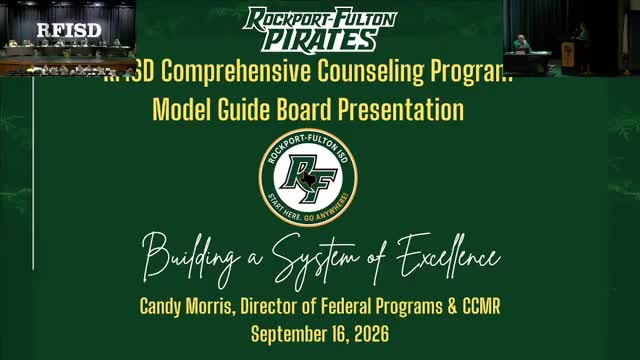
Summary
District counselors presented a new Rockport‑Fulton comprehensive counseling model aligned with state guidance and the district strategic plan; the district is rolling out virtual counseling (Daybreak Health), wellness rooms, career centers and staffing funded by grants and CCMR to expand services.
Rockport‑Fulton ISD’s counseling team presented a new districtwide comprehensive counseling model on Sept. 16 that aligns the district’s counseling goals with state standards and the board’s strategic priorities, and described new mental‑health and career supports coming to campuses.
Candy Morris, district counseling director, said the model was developed over the past year to be a practical, district‑wide guide for counselors rather than a long, prescriptive manual. The plan is aligned with the Texas counseling model and the district’s strategic priorities; it sets out delivery components — guidance curriculum, individual planning, responsive services and system support — and includes tools and parent resources the counselors will publish to the district website.
Morris described several initiatives either in place or starting this year:
• Daybreak Health: a virtual counseling option staffed by licensed counselors; the district said Daybreak was offered at no startup cost but families would bill health insurance or Medicaid for clinical services when required. Counselors will identify students who may benefit and support referrals.
• Counseling wellness centers: each campus is creating a space for students and teachers to use for calming, small group work or restorative practice; those spaces were funded in part by grants.
• Career exploration centers: classrooms or library corners on each campus will provide career resources, and the district is using Xello for career exploration and mapping. Staff said the effective advising framework used with the region aims to align elementary grade‑level career experiences to high‑school CTE and CCMR (College, Career and Military Readiness) pathways.
• Staffing and new positions: the district has a district LPC (licensed professional counselor), Kelly Pape Sims, and a CCMR‑funded college‑career counselor to replace previous advisor positions; a part‑time senior advisor funded by an Education‑to‑Employment grant will start in October.
Morris said staff are continuing to update suicide protocols, safety plans and guidance curriculum (Quaver, Goodheart‑Willcox for secondary), and to map grade‑level expectations across campuses so students receive consistent advising from kindergarten through high school. She also noted a Hope Squad suicide prevention program and student‑led Kindness Squad expansions at elementary campuses.
Board members asked about consent requirements for certain health and human‑trafficking topics: counselors noted state law requires parental consent for some topics and that the district is using Skyward to collect required opt‑ins/opt‑outs under recent legislation. The district asked parents to complete release forms so counselors can deliver the planned curriculum.
No board vote was required. Counselors will post the new counseling model and parent resources on the district website and continue to implement pilot supports this school year.