
Milton webinar spotlights trauma, grief and local suicide-prevention efforts
Get AI-powered insights, summaries, and transcripts
Subscribe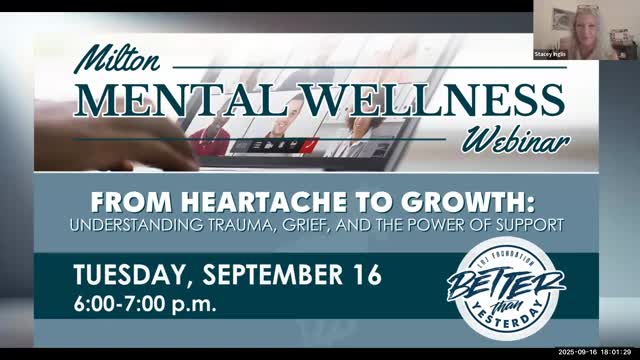
Summary
City of Milton and partners presented coping strategies, evidence-based treatments and community support options during the Milton Mental Wellness webinar; two sisters who lost their father to suicide described organizing a Run Towards Tomorrow 5K that raised more than $7,000 for prevention work.
City of Milton hosted its seventh annual Milton Mental Wellness webinar featuring mental-health professionals, community leaders and two sisters who lost their father to suicide. Presenters described how trauma and grief affect the body and brain, outlined coping skills and therapies, and highlighted community resources and a local survivor-organized fundraiser that raised more than $7,000.
The program, opened by Mayor Payton Jamieson, brought together the LRJ Foundation and counselors from Johns Creek Alpharetta Counseling (JCAC) to “raise awareness, share resources, offer support, and do what we can to reduce the stigma around discussing one's mental health struggles,” Jamieson said. JCAC clinicians described practical first-line strategies people can use when triggered and when to seek a trauma specialist.
"A definition, a really great definition, is that it's a severe emotional response to a stressful event that overwhelms a person's ability to process the whole trauma emotionally," said Jenny Vose, a licensed professional counselor and certified traumatologist with JCAC. Vose explained that trauma becomes stored in the brain—often in the amygdala—so that triggers (sights, sounds, smells or even colors) can make a survivor feel the event is happening again. She described the amygdala response as an activation of "fight, flight, or freeze," which can temporarily shut down the brain’s logical, prefrontal cortex.
Vose recommended grounding and regulation techniques for immediate relief—breathing exercises, progressive muscle relaxation and bilateral stimulation—and said many trauma reactions improve within four to six weeks with self-care. "Normally the effects of trauma will subside by themselves in 4 to 6 weeks," she said, adding that persistent flashbacks, nightmares, strong somatic responses or inability to carry out daily duties after that period are signs to seek professional treatment.
Presenters summarized evidence-based therapies used in trauma treatment. Vose described EMDR (eye movement desensitization and reprocessing) as a treatment that uses bilateral stimulation to help move traumatic memories from the amygdala to the prefrontal cortex so they become memories rather than ongoing threats. She also cited cognitive processing therapy (CPT), emotionally focused individual therapy (eFIT), and trauma-focused cognitive behavioral therapy (TF-CBT) as commonly used approaches.
On grief, Rachel Bridal, an associate professional counselor with JCAC, said grief and trauma often overlap. "Grief healing really focuses on honoring the lost, expressing emotions, and finding ways to carry the love forward," Bridal said. She emphasized that grief is not linear, often returning in waves, and that supporting someone in grief is more about presence than fixing: offer specific help, listen, validate feelings and remember important dates rather than relying on generic phrases.
The webinar also included a survivor account. Sisters Maddie and Riley Paul described losing their father, Brad Paul, to suicide on Aug. 23, 2024, and the steps they’ve taken since. "My father, Brad Paul, died by suicide on 08/23/2024," Maddie said. The sisters said they leaned on therapy, community, journaling and small rituals to cope; Riley described using EMDR and both described journaling letters to their father as a way to process day-to-day moments.
Maddie and Riley turned their grief into a community fundraiser. Inspired by a detail from their father’s sock drawer, they organized the Run Towards Tomorrow 5K, which they said raised more than $7,000 to support suicide-prevention work through the LRJ Foundation. "People showed up. They shared their stories. They ran. They walked, and we even wore our socks," Maddie said.
Speakers and organizers reminded attendees that resources and follow-up contacts would be posted on the City of Milton website and that JCAC maintains free guided-imagery resources on its YouTube channel and podcast. City staff also previewed a fall mental-health fair at the City of Milton Community Center on Oct. 25 that will include family activities and resource tables.
The webinar combined clinical explanation with survivor experience and local outreach: clinicians outlined thresholds for seeking therapy, grief specialists advised on ongoing support, and community members described fundraising and peer connection as part of their recovery. Attendees were directed to the LRJ Foundation and JCAC for follow-up questions and to the City of Milton website for posted materials and contact information.