
Kent Council unanimously adopts 0.1% sales tax to fund additional police and criminal‑justice positions
Get AI-powered insights, summaries, and transcripts
Subscribe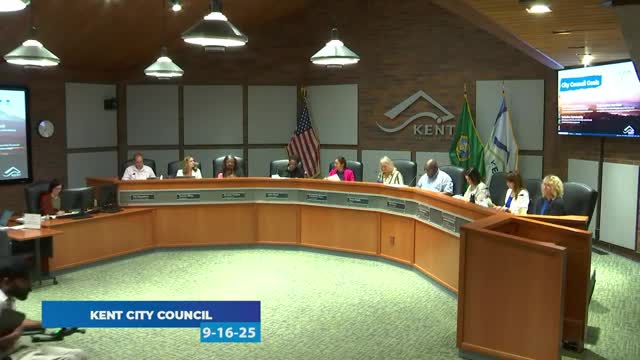
Summary
The Kent City Council voted 7–0 on Sept. 16 to adopt Ordinance No. 4522, imposing a one‑tenth of 1 percent sales and use tax dedicated to criminal‑justice purposes and to create and fund new positions in the local criminal‑justice system.
The Kent City Council voted 7–0 on Sept. 16 to adopt Ordinance No. 4522, imposing a one‑tenth of 1 percent sales and use tax dedicated to criminal‑justice purposes and to create and fund new positions in the local criminal‑justice system.
City leaders said the measure is meant to address what staff described as a long‑running imbalance between Kent’s public‑safety needs and the city’s share of sales tax revenue, a consequence they tied to the region’s 2008 change to destination‑based sales tax allocation and Kent’s large industrial and warehousing base.
Council members heard a series of presentations before the vote. Pat Fitzpatrick, chief administrative officer, summarized the city’s fiscal position and the origin of the proposal, saying Kent’s economy heavily depends on warehousing and industrial land and that under the state’s destination approach Kent receives less sales tax revenue than it did under the prior origin‑based system. Fitzpatrick told the council the city has sought mitigation from the Legislature in prior sessions and that mitigation will lapse next year.
City Attorney Tammy White outlined statutory steps required by House Bill 2015 and said Kent submitted documentation to the Washington State Criminal Justice Training Commission (CJTC) to demonstrate eligibility. "The CJTC has acknowledged receipt of that. We have not received any information back from CJTC that our submittal is deficient as of yet," White told the council, and she noted that state law allows the city to adopt the tax while curing any deficiencies within 180 days if necessary.
Finance Director Paula Painter presented the city’s revenue and household impact estimates. Painter said the ordinance would allow Kent to implement the tax on Jan. 1, 2026, provided the city files the required 75‑day notice to the Department of Revenue by Oct. 15, and the city would first receive the additional collections on March 31, 2026. The finance director estimated annual revenue from the tax at approximately $3,650,000 and said the typical Kent household at the city median income of about $90,000 would pay roughly $3 more per month in sales tax, calculated using a working assumption that about 40 percent of household income is spent on taxable goods.
Rafael Padilla, chief of police, described the police staffing picture and how the city would use the new revenue. Padilla said Kent’s authorized commissioned strength is 170 officers and that the department had five vacancies at the time of the meeting; he said Kent ranks in the lower third of Washington cities on officers‑per‑capita and has a higher volume of 911 calls than neighboring valley cities. Padilla said the council‑adopted ordinance would fund the hiring of roughly 10 additional officers, plus supporting positions that are likely to include a corrections officer, an evidence custodian, an additional prosecutor and an additional public defender, and other noncommissioned staff created by the expanded caseload. "This does not fix our staffing holes. This still falls short in the area of about 20 to 25 officers," Padilla said, adding that the funds would nonetheless “move the needle” on response times, officer workload and retention.
The ordinance as adopted includes findings of eligibility under House Bill 2015, sets the tax to go into effect on sales events occurring Jan. 1, 2026, directs the finance director to file the required notice with the Department of Revenue and creates a restricted fund to hold and track the revenue. City Attorney White and staff emphasized the ordinance requires the revenue to be used for new, additional criminal‑justice positions and not to supplant existing public‑safety funding.
Council Member Boyce moved adoption of Ordinance No. 4522; the motion was seconded and passed on a 7–0 vote. The ordinance authorizes the finance director to amend the budget when revenues are received and requires council authorization before individual positions are filled. City staff said hiring could begin in January 2026 if council subsequently authorizes the positions, because budget accounting will treat the estimated annual revenue as a calendar‑year budget.
Staff cautioned that separate grant funding authorized under House Bill 2015 remains uncertain: criteria, award amounts and prioritization for CJTC grants had not been finalized at the time of the meeting. Tammy White noted that Kent’s early compliance with HB 2015 policies could place the city lower in priority for some grant categories, because grant priorities will favor jurisdictions that have not yet implemented certain reforms.
The council also discussed the household cost of the tax and the equity tradeoffs involved. Council members who supported the measure acknowledged the impact on lower‑income households while saying the revenue is necessary to improve public safety and that the city has pursued state solutions without success.
Next steps identified by staff: file the 75‑day notice with the Department of Revenue by Oct. 15; set up a restricted revenue account; draft position‑authorization ordinances and a hiring plan to return to the council for approval; and continue monitoring CJTC grant rules and deadlines.
Local officials said the revenue would be tracked in a dedicated account and reported transparently to show compliance with the ordinance and state law.