
Longmont staff present 2026 proposed budget and five-year capital improvement plan; utilities and facility maintenance among top priorities
Get AI-powered insights, summaries, and transcripts
Subscribe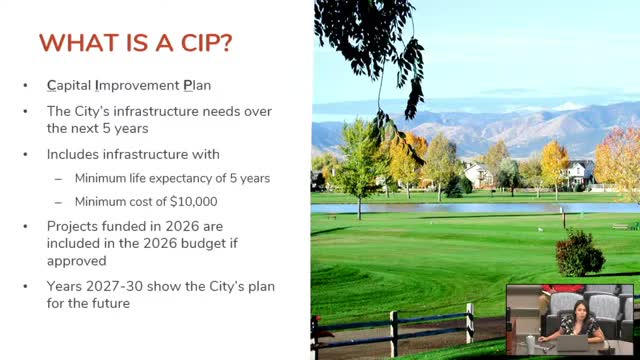
Summary
City staff on Tuesday delivered a multi-hour overview of the proposed 2026 budget and the 2026–2030 Capital Improvement Program, reporting a proposed 2026 CIP of $93.2 million and highlighting transportation, water and electric as top categories for capital spending.
City staff on Tuesday delivered a multi-hour overview of the proposed 2026 budget and the 2026–2030 Capital Improvement Program (CIP), telling councilmembers that transportation, water and electric projects will anchor capital investments while aging buildings and utilities will require continued reinvestment.
CIP and budget totals: Budget staff reported a revised 2025 CIP total of about $256 million, of which $185 million (72%) is carryover from prior years and $71 million (28%) was adopted in last year's CIP. For 2026, staff proposed $93.2 million in CIP funding and a five‑year CIP total of roughly $357.8 million. "Projects that are showing funded status in 2026 are included in the proposed budget," Budget Manager Sandra Cifuentes said, noting that the 2025 spike reflects available appropriations and carryover rather than single‑year spending.
Utility funds and rates: Multiple department presentations flagged utility funding pressure and the need for rate conversations. Longmont Power & Communications (LPC) staff presented a proposed 2026 electric budget about 9% above 2025 and said an electric rate increase would be necessary to close an estimated $8 million gap between projected revenues and planned spending; LPC staff told council the utility will return with a formal rate proposal soon. LPC highlighted investments in distributed energy resources, batteries, substation capacity improvements, reliability work and wildfire mitigation-related technology.
NextLight broadband: NextLight’s executive director presented a proposed budget in which operating revenue was cited at roughly $23 million and the utility expects to add about 600 net subscribers in calendar-year 2026. NextLight said it plans CIP and capacity investments and that its outstanding debt is scheduled to be retired in 2029, which will bolster its fund balance. Staff discussed fiber undergrounding strategy and coordination with LPC projects; NextLight noted it follows LPC’s undergrounding schedule and pursues targeted overhead armoring where needed.
Facilities and major building maintenance: Facilities staff described major rehabilitation work at the Safety and Justice Center that followed structural and water-infiltration problems discovered during inspections and demolition phases. Senior project manager Charice Montgomery said the building now meets requirements for an essential facility category under the International Building Code after two years of structural rehabilitation and that structural rebuild work is scheduled to begin later this year. City managers said repeated work on older city buildings demonstrated the need to shift toward proactive, lifecycle maintenance rather than reactive repairs.
Parks and other departments: Parks staff proposed continued investment in park renewal and highlighted Sandstone Ranch Phase 4 (four new ball fields and associated infrastructure) and the park renewal program to replace aging playgrounds, irrigation and other assets. Other presenters summarized sanitation, sewer, water, storm drainage and transportation CIP items, including replacement of cast-iron distribution pipe, raw-water diversion and irrigation improvements, annual sewer rehabilitation (including trenchless relining), Resilient St. Vrain Project design work and multiple street and multimodal projects (asphalt pavement management, Pace Street improvements, Kaufman Street mobility work and the Boston Avenue connection tied to future regional transit).
Sanitation and sewer: Staff told council the sanitation fund faces pressure from rising truck and equipment costs, changing revenue sources (oil & gas, RIN credits) and increasing tipping fees and presented proposed reductions that would be reversible if a pending rate proposal is adopted. The sewer fund presentation said the wastewater plant treats about 7 million gallons per day and that a previously studied anaerobic digester project remains a possible future investment to increase biogas production and resiliency; staff are updating a wastewater master plan to guide future CIP and regulatory compliance.
Transportation and storm drainage: Engineering staff highlighted the transportation fund's program priorities — safety, multimodal access and asset management — and said planned 2026 projects include pavement management, traffic‑safety upgrades, railroad quiet‑zone packages and the Kaufman Street/BRT station area and Kauffman Street extension work. Storm drainage staff highlighted continued investment in the Resilient St. Vrain Project and year‑over‑year increases in storm‑drain CIP to address older pipes and localized flooding risk.
Technology services fund: Staff proposed creating a new internal technology services fund to centralize enterprise technology investments, billing internal users and better track software and infrastructure costs. The 2026 proposal included about $2.0 million of technology investments including term‑limited staff and professional services related to the city’s Salesforce implementation, expanded analytics and customer‑experience work, and asset and project‑management system development. Staff described the fund as a tool to align technology expense and benefits across departments.
Timing and next steps: Staff said they will continue rate conversations with council (electric and sanitation were highlighted) and will bring ordinances and budget resolutions through the city's formal hearings schedule. The next budget-related meeting is scheduled for Sept. 30 if needed; upcoming hearings and a public hearing are part of the autumn budget-adoption calendar.
What council heard: staff emphasized the need to finish existing projects before taking on many new ones, to coordinate undergrounding and utility relocations with street projects, and to strengthen proactive facilities maintenance funding to avoid larger future costs. Presenters noted material and labor inflation, supply-chain constraints, and the ongoing need to prioritize projects by risk, condition and equity.