
Kenmore planning commissioners refine PROS goals and policies, set special meeting and public hearing
Get AI-powered insights, summaries, and transcripts
Subscribe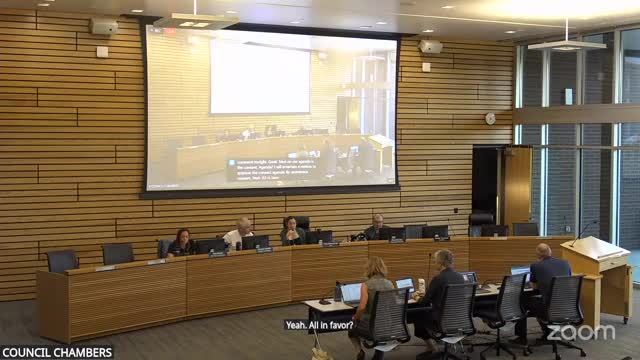
Summary
Kenmore Planning Commission members spent the bulk of their Sept. 16 meeting reviewing draft goals, objectives and policies for the city's Parks, Recreation and Open Space (PROS) element, proposing new wording on shoreline buffers, Indigenous cultural recognition, accessibility and land-acquisition practice and asking staff to incorporate the edits before a special meeting and a public hearing.
Kenmore Planning Commission members spent the bulk of their Sept. 16 meeting reviewing draft goals, objectives and policies for the city's Parks, Recreation and Open Space (PROS) element, proposing new wording on shoreline buffers, Indigenous cultural recognition, accessibility and land-acquisition practice and asking staff to incorporate the edits before a special meeting and a public hearing.
The discussion matters because the PROS element will guide park, trail and open-space decisions in Kenmore and feed into the comprehensive plan, shaping where city resources and capital projects are prioritized.
Todd Hall, principal planner for the City of Kenmore, said the packet provided both redline and clean copies of the draft goals, objectives and policies and asked the commission to focus discussion on those sections. "We wanted to make sure that we captured your comments and feedback correctly from last time," Hall said. He told the commission staff would incorporate the edits and return with updated material ahead of the hearing.
Commissioners suggested several substantive edits and clarifications. Commissioner Macias proposed a new policy (noted in the meeting as P1.2.0.3) that would require planners to "allow sufficient space from the shoreline for natural ecosystem processes when considering waterwalk trail locations, especially those involving hardscapes, for example, asphalt, concrete, boardwalk, etcetera." Several commissioners signaled support for that language.
Members also debated wording on habitat and riparian restoration. One commissioner proposed replacing a draft phrase that promoted a master plan to "explore opportunities for continuing habitat and riparian corridor restoration and opportunity for public access" with wording that would require plans to "explore opportunities for continuing habitat and riparian corridor restoration and opportunity that include public access when appropriate." That change was discussed as a way to emphasize restoration while reserving public access in locations where it would not harm habitat.
Commissioners asked staff to call out Indigenous history and cultural interpretation in the PROS policies. Commissioners suggested adding or cross-referencing language that would incorporate Indigenous and community history into interpretive signage and cultural elements in parks, and noted that some comments on Indigenous recognition might better fit under cultural-goal language elsewhere in the document.
Accessibility and equity also drew repeated attention. Commissioners called for inclusive-play and ADA considerations to be "infused throughout" the element rather than limited to a single sentence, and for explicit language to ensure park design and programming consider the needs of people with disabilities and other underserved groups.
On transportation and connectivity, commissioners supported language promoting safe, multimodal and nonmotorized access to parks and trails, and proposed editing objective 3.1 to explicitly note that trail and active-transportation projects should support both regional and local destinations.
Commissioners and staff discussed partnerships and joint use with school districts. Several members urged stronger language encouraging partnerships with multiple local districts rather than a single district, and said stronger, active outreach may be necessary because some districts have not participated in facility-sharing in the past.
The commission debated how to treat older "master plans" for individual parks and how to handle long-standing but unimplemented recommendations. Several commissioners suggested treating legacy master plans as historical documents that should be annotated (for example, explaining why a recommendation was not implemented) and using guiding principles for each park's purpose (environmental preservation, waterfront access, active recreation, etc.) rather than re-opening every past controversy verbatim.
Commissioners also discussed acquisition policy. One commissioner asked whether the city should allow opportunistic land acquisition before the full capital, operations and mitigation budgets are in place, noting that land prices can rise and that holding property could enable future park projects. Staff agreed to draft clarified policy language to reflect acquisition flexibility while noting budget implications.
Climate and urban-heat considerations were raised in several exchanges. Commissioners referenced a draft heat-island map and asked that the PROS documentation better connect tree canopy, shade and distributed pocket parks to climate-resilience goals in other plan elements.
Chair Banashinski and staff clarified next steps: the commission scheduled a special meeting the following week and expected a public hearing two weeks later, with a tentative recommendation to the City Council scheduled for Oct. 20. Hall told commissioners staff would incorporate the commission's edits, update maps and narrative, and return with a more polished packet and the draft PROS plan styling for final review.
No formal motions or votes on policy language took place during the Sept. 16 session; commissioners provided direction to staff and requested ancillary edits, additional data and clearer cross-references between the PROS element and the PROS plan.
For context, the discussion followed an introduction by Terry Kilgore, the city manager, who had just started work with the city and said she looked forward to seeing the commission's recommendations for the PROS element.
What happens next: staff will incorporate the requested edits (shoreline-buffer language, Indigenous and accessibility references, acquisition-policy clarification and other drafting changes), finalize updated maps, and present a revised draft at the special meeting and the public hearing scheduled in the coming weeks.