
Kenmore planning commissioners refine PROS goals; public hearing set after edits
Get AI-powered insights, summaries, and transcripts
Subscribe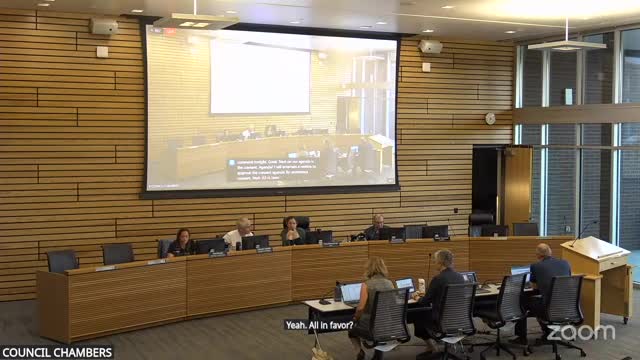
Summary
At a Sept. 16 meeting, the Kenmore Planning Commission reviewed the Parks, Recreation and Open Space (PROS) element of the comprehensive plan, proposing wording changes on shoreline setbacks, habitat restoration and inclusivity, and directing staff to incorporate edits ahead of a special meeting and a public hearing.
The Kenmore Planning Commission continued its review of the Parks, Recreation and Open Space (PROS) element of the city comprehensive plan on Tuesday, Sept. 16, focusing on goals, objectives and policies and directing staff to incorporate commissioner edits before a special meeting and a public hearing scheduled two weeks later.
The session matters because the PROS element sets priorities for park projects, land acquisition, stewardship, access to Lake Washington and the Sammamish River, and policies covering equity, accessibility and climate resilience that will guide future capital spending and development.
Todd Hall, the city’s principal planner, opened the item by asking commissioners to focus on the goals, objectives and policies in the packet and noting staff had included redline and clean copies along with a crosswalk to other comprehensive plan elements. "Good evening, commission. Todd Hall, principal planner. Tonight, we continue our discussion regarding the PROS plan and PROS elements," he said.
Commissioners debated language at the top of the goals section that addressed how readily goals and policies may change. Some favored keeping an explicit statement that changes should be made cautiously; others said the provision could be rephrased in the positive to allow updates in response to shifting community values or new data.
Commissioner Macias proposed a new policy to guide shoreline trail design, offering proposed text for the packet: "Allow sufficient space from the shoreline for natural ecosystem processes when considering water walk trail locations, especially those involving hardscapes, for example, asphalt, concrete, boardwalk, etcetera." That wording earned immediate support to record the proposal for incorporation into the draft.
On habitat and public access, commissioners suggested rewording a proposed master-plan policy to clarify that restoration plans should "include public access when appropriate," rather than assuming access as the default. Commissioners also asked staff to separate the idea of identifying resource-management agencies for technical guidance from the idea of recruiting volunteer stewards, so that agencies would be cited for technical consultation and nonprofits or community groups would be identified as stewardship partners.
Several commissioners pressed for more explicit recognition of Indigenous history in the element and several suggested adding language calling for interpretation and cultural elements that reference longer Indigenous presence, in addition to more recent community history.
Accessibility and equity were recurring themes. Commissioners recommended infusing accessibility language throughout the PROS policies, especially for playgrounds and trail connections, and asked that safe multimodal connections be framed to support both regional and local destinations. One commissioner asked that Americans with Disabilities Act (ADA) accessibility be referenced in relevant policies.
Land-acquisition policy drew particular discussion. Commissioners asked staff to clarify whether the city should allow opportunistic acquisition of property when it becomes available even if operating and capital maintenance funds are not yet budgeted; commissioners said opportunistic acquisition can preserve strategic opportunities when parcels appear on the market. Staff agreed to draft language reflecting that approach for commissioners to review.
Climate resilience and urban heat concerns were raised repeatedly. Commissioners asked that the plan connect park and street vegetation to heat-island mitigation and that maps (including a heat map) be included or refined; staff said the city’s GIS analyst was updating maps to be consistent with other plan elements.
Staff outlined next steps: a special meeting the following week to continue edits, a public hearing roughly two weeks later, and a tentative council hearing scheduled for Oct. 20 to consider the commission’s recommendation. Hall said staff would return with updated wording, refreshed maps and an edited PROS plan for additional review.
Terry Kilgore, the city manager who introduced herself at the start of the meeting, thanked the commission and said she looked forward to working with the group as the PROS work continues.
The meeting also approved the consent agenda by unanimous consent early in the session. No formal votes on PROS policies were taken; the discussion produced direction to staff rather than final action.
Staff and commissioners agreed to incorporate the suggested edits, clarify where policy language belongs in the element versus the PROS plan, and return the revised materials for further review before the public hearing and forwarding a recommendation to the City Council.