
Piedmont Community Charter receives C school-performance grade; growth score falls below state threshold
Get AI-powered insights, summaries, and transcripts
Subscribe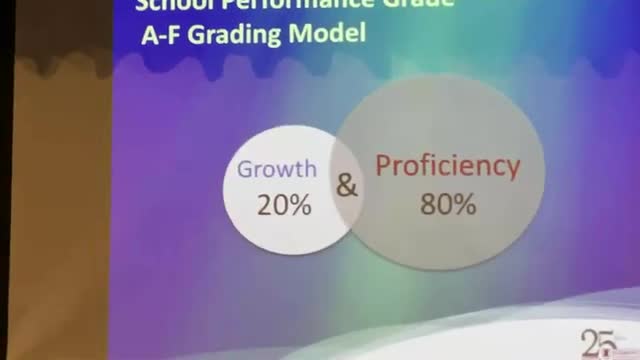
Summary
At the Sept. 16 board meeting, a school presenter explained the North Carolina Department of Public Instruction model and reported a C grade for 2024–25, a growth score of -2.22 and a four-year graduation rate of 97.4%.
Miss Hufstedler, presenting the North Carolina Department of Public Instruction accountability model to the Piedmont Community Charter School Board of Directors on Sept. 16, said the school received an overall performance grade of C for 2024–25, with a growth score of -2.22 and a four-year graduation rate of 97.4%.
Under the state model described by Miss Hufstedler, 20% of a school’s performance grade is based on growth and 80% on proficiency. She said growth compares individual student performance to expected performance based on prior testing history; proficiency compares students to a standard measured on End-of-Grade (EOG) and End-of-Course (EOC) assessments.
The presentation included subject-level results: the school reported high grade-level proficiency in several tested subjects, with a cited overall grade-level proficiency figure of 90.3% for students enrolled in Math 3. Miss Hufstedler said that metric placed Piedmont among the top 12 traditional public schools in North Carolina, and she reported math-course rigor above the state’s 95% benchmark for seniors who completed Math 3 prior to graduation. She also reported that Piedmont’s grade-level proficiency across grades 3–12 was 15.4 percentage points higher than Gaston County Schools and 8.8 points higher than the state; the school’s college-and-career-readiness measure was 11.7 points higher than the county and 6.1 points higher than the state.
Miss Hufstedler framed the growth metric ranges used by the state: meeting growth requires a score between -2 and 2; exceeding growth is above 2; not meeting growth is below -2. The school’s reported growth of -2.22 therefore fell below the state’s “meet” threshold.
This was an informational presentation; the board did not take formal action on the performance grade at the meeting. The presenter answered board questions about the components of the state model and reviewed 11 years of EOG/EOC proficiency trends as shown in the slides.
Board members and staff may use this report in upcoming planning and strategy sessions; no policy change or vote on accountability matters was recorded at the Sept. 16 meeting.