
Council reviews draft multifamily tax-exemption ordinance and target-area maps
Get AI-powered insights, summaries, and transcripts
Subscribe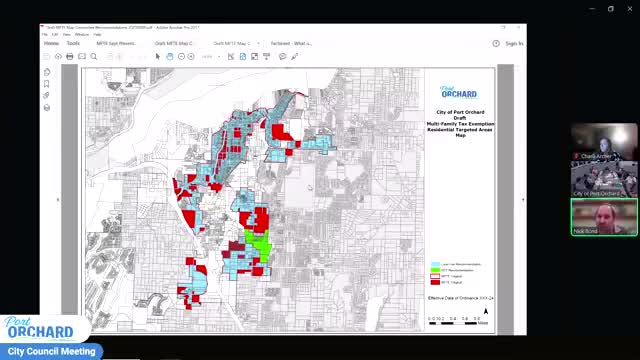
Summary
Director Nick Bond presented a draft multifamily tax exemption (MFTE) ordinance offering 8‑ and 12‑year options with targeted eligibility criteria and maps; council members discussed tax-shift tradeoffs, map boundaries and reporting burdens and asked staff to schedule a public hearing.
Director Nick Bond presented a draft multifamily tax‑exemption ordinance at the Sept. 16 work study that would reintroduce 8‑ and 12‑year MFTEs and add eligibility criteria to encourage higher-value and middle-housing projects.
The proposed ordinance matters because MFTEs waive property tax on improvements for a period of years to incentivize certain housing types; the council's draft would use eligibility criteria (mixed-use shopfronts, buildings of four or more stories, middle‑housing clusters of 4–12 units on small lots, or projects that place 100% of parking below grade) to target incentives toward projects the city deems to bring higher long‑term value.
Bond said the 12‑year exemption would continue to require that at least 20% of units be offered at a discount; the draft increases that rent discount in the ordinance from 10% (the previous program) to 25% below fair-market rent for those affordable units, and requires income‑eligibility verification. The intent, Bond said, is to make affordable units meaningfully cheaper while encouraging larger or vertically denser projects that provide more long‑term taxable value.
Council members and committees differed about map boundaries. The land‑use committee recommended removing institutional parcels that cannot practically redevelop (for example, parks and schools) to avoid confusion; the economic‑development committee recommended adding an inland corridor between centers to include areas where redevelopment and infill are policy priorities. Council members asked staff to finalize a map that retains the economic‑development committee's green additions while clarifying that zoning and view‑overlay limits remain binding and that being mapped does not automatically change land‑use rules.
Council members also discussed tax-shift impacts. Bond showed a hypothetical case study in which a denser four‑story building yields greater long‑term tax revenue than a three‑story project; staff estimated the incremental annual tax shift from a single illustrative project would average about $10.36 per property owner in the city during the exemption period. Several council members asked that the city obtain developer feedback on whether the 25% rent discount for affordable units is financially viable; Bond said the kitsap builders association planned outreach and that public hearings will give additional input.
On reporting and administration, Bond noted the 12‑year exemption imposes ongoing state reporting and auditing obligations and that applicants must submit annual reports; the city cannot charge an annual monitoring fee (only an up‑front application fee), so staff advised they would need to absorb verification work or contract for it if applications grow.
Council asked staff to finalize maps consistent with the discussion and to schedule a public hearing; staff will check whether SEPA or additional notices are required and bring the ordinance forward for public hearing and subsequent council action.