
Council weighs sewer rate options; staff recommend public hearing on higher rate to fund two maintenance positions
Get AI-powered insights, summaries, and transcripts
Subscribe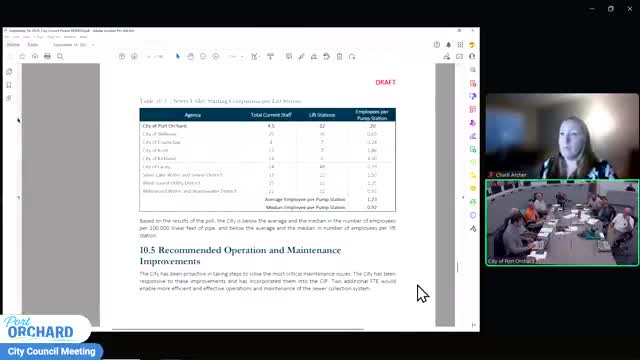
Summary
City staff presented an FCS Group rate study showing a 3.5% revenue need under baseline assumptions and a 4.5% alternative that would fund two additional sewer maintenance full-time employees; council directed staff to present the higher table at the upcoming public hearing while debate continued.
City staff introduced an FCS Group sewer rate study at the Sept. 16 Port Orchard work study that estimated how much revenue the utility needs to meet operations, debt and capital obligations through 2030 and showed two financing options: a baseline that would raise revenue about 3.5% over the next five years, and an alternative (4.5%) that would add funding to hire two additional sewer maintenance full‑time employees (FTEs).
The rate study and staffing choice matter because they determine whether operations capacity will expand to complete proactive maintenance work (CCTV, pump‑station servicing, pipe replacement) or remain constrained and largely reactive.
FCS Group's analysis, as presented by staff, showed that under the simplified rate structure (one residential and one nonresidential rate replacing a 20+ category nonresidential table), the residential bi‑monthly charge would be about $1.51–$1.53 per equivalent unit in the early years of the plan (the presentation noted the city's current published rate as $1.63). Staff explained that adding the two FTEs increases the modeled revenue requirement by roughly one percentage point (~4.5% total) compared with the no‑FTE baseline (~3.5% total). Council members asked for clarity on timing and phasing; staff said the assumption used in the study was one FTE added in 2026 and one in 2027 and that one vehicle was included in the FTE costs.
Councilors discussed alternative approaches to phasing the increases: several suggested averaging the six-year schedule to a single, flat change to reduce year‑to‑year variability; others favored the stepped approach the consultant modeled. Several council members said they supported adding the two FTEs to improve maintenance and reduce long-term emergency costs; at least one councilor objected to introducing a higher rate option on short notice.
On procedural details, staff said statutory notice requirements vary by issue: budget hearings require two consecutive weeks posting, while the typical public-notice practice for utility-rate public hearings is five to seven days; staff said they would publish notice as required and that the council will hold a public hearing next week with a subsequent second hearing about two weeks later before any final action.
At the end of the discussion the council directed staff to bring the 4.5% table forward to the public hearing process so residents could comment; staff will prepare an ordinance and notice for the Council's public hearing schedule. No formal vote to adopt rates occurred at the work study.