Get Full Government Meeting Transcripts, Videos, & Alerts Forever!
Get email alerts on the School Nutrition Policy topic
No spam. Unsubscribe anytime.
District staff recommends opt-out from "Breakfast After the Bell" mandate for Joliet Central and Pathways
Summary
Julie Adelman, director of student support services, presented a cost analysis and recommended the district opt out of the state 'Breakfast After the Bell' mandate for Joliet Central and Pathways citing reimbursement shortfalls and operational disruption; the board held and closed a required public hearing and received no public comment.
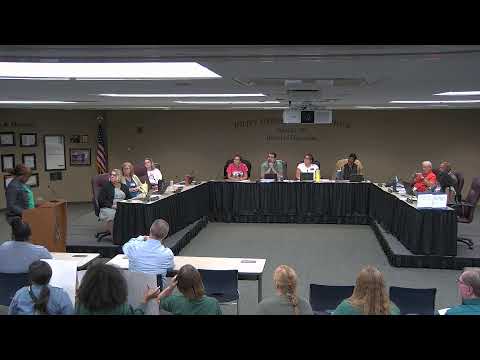
Julie Adelman, the district’s director of student support services, told the Joliet Township High School Board of Education that she recommends the district opt out of the state’s "Breakfast After the Bell" mandate for schools where at least 70% of students are eligible for free or reduced-price lunch. Adelman said Public Act 99-0850 requires schools with at least 70% eligibility to provide breakfast after the instructional day begins, but that the district’s cost analysis shows state and federal reimbursements would not fully cover the additional costs of serving meals outside the established cafeteria locations. "I do recommend that the district opt out for the following reasons," she said during her presentation. Adelman gave operational and financial details: Joliet Township High School (JTHS) currently averages about 1,589 breakfast meals daily (an increase of 543 from the 2023–24 school year). Reimbursement rates cited for the 2025–26 school year were $2.94 for free meals, $2.64 for reduced-price meals and $0.40 for paid meals. She said implementing breakfast after the bell would require expenditures for coolers or refrigerators, carts, additional staff for distribution and custodial support, wireless point-of-sale equipment, extra supervision and possible schedule changes that could shorten class periods or extend the school day. Adelman also summarized the opt-out procedural steps the district must follow: submit a cost analysis, hold a public hearing (which the board opened and closed at the meeting), post required notices on the district website and notify the Illinois State Board of Education (ISBE) in writing 14 days prior to the hearing; if the board passes a resolution finding cost prohibitive, the district must submit that resolution to ISBE. At the meeting, no members of the public spoke during the hearing; the board closed the hearing and took no immediate vote to adopt an opt-out resolution. The board did not vote on an opt-out resolution at this meeting; staff said the cost analysis and hearing are preparatory steps required before a formal resolution would be considered.