Get Full Government Meeting Transcripts, Videos, & Alerts Forever!
Get email alerts on the Jail Capacity topic
No spam. Unsubscribe anytime.
Supervisors split over bed count for proposed jail; item tabled for further negotiation
Summary
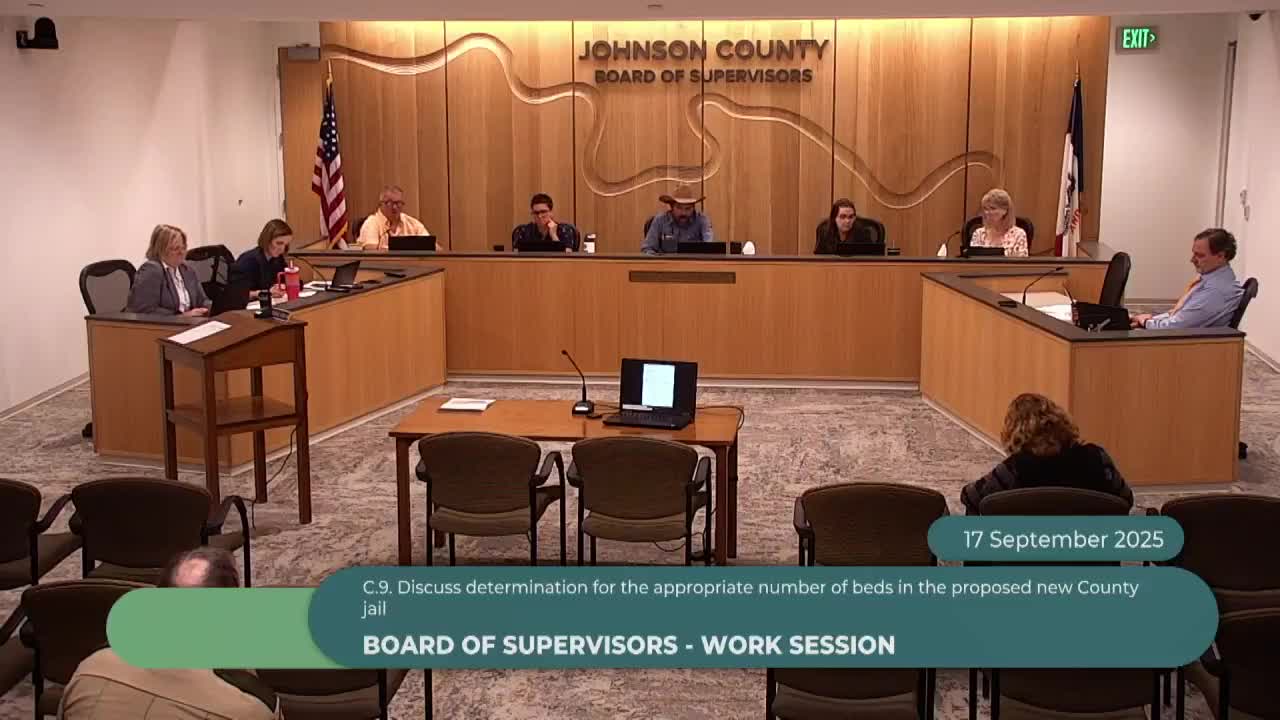
Supervisors debated whether a new county jail should be limited to about 92–100 beds or built to a 120–140 footprint for future growth and a potential joint facility with Iowa City; the board agreed to continue the discussion at a Sept. 24 work session and to seek bond counsel input.
Supervisors spent the work session debating the appropriate bed count and footprint for a proposed new county jail and possible joint law‑enforcement facility with the City of Iowa City. The city council passed a separate resolution (4–3) supporting further work on a joint authority but with the mayor's condition that a Riverside Drive site would not be used, prompting the county to accelerate property identification.
Some supervisors argued for a conservative approach: keep the initial built bed count at 92 — roughly double current in‑facility capacity and in line with recent average daily population figures — and pair a bond proposal with investments in community‑based alternatives such as mobile crisis, mobile integrated health and other diversion supports. "The data really doesn't show a need for any more beds than 92," one supervisor said, citing five‑year averages and public feedback on cost and criminalization concerns.
Other supervisors and the sheriff urged a larger footprint. Sheriff Brad Conkle and facility planners recommended a design with 120 beds built out and shell space to expand to 140 should future needs justify it, and said a larger number of housing units improves the county's ability to segregate populations (medical, mental health, juveniles, pretrial) and reduce out‑of‑county placements. "We have 32 full‑time detention staff," the sheriff noted, comparing staff levels with similar counties and arguing staffing is in place to support a larger facility footprint.
Board members discussed compromise options including a 120‑bed buildout with shell space for 140 and the possibility of pairing a jail bond with a separate community investment ballot measure. One supervisor proposed placing a first question to build 120 beds with shell to 140 and a second, dollar‑for‑dollar community investment measure on a later ballot; other supervisors expressed concerns about feasibility and whether bonding could finance non‑capital services.
The supervisors directed staff to obtain bond counsel input on bonding limits and allowable uses, and tabled the substantive bed‑count decision to a Sept. 24, 2025 work session at 1:30 p.m. for a broader negotiation that would include city officials and other stakeholders.