Get Full Government Meeting Transcripts, Videos, & Alerts Forever!
Get email alerts on the Juvenile Diversion topic
No spam. Unsubscribe anytime.
Johnson County officials outline juvenile diversion, court process and detention screening
Summary
Juvenile court and county attorney staff briefed supervisors on pre‑charge diversion options, intake screening and court outcomes, providing data on petitions, diversion buckets and detention screening procedures.
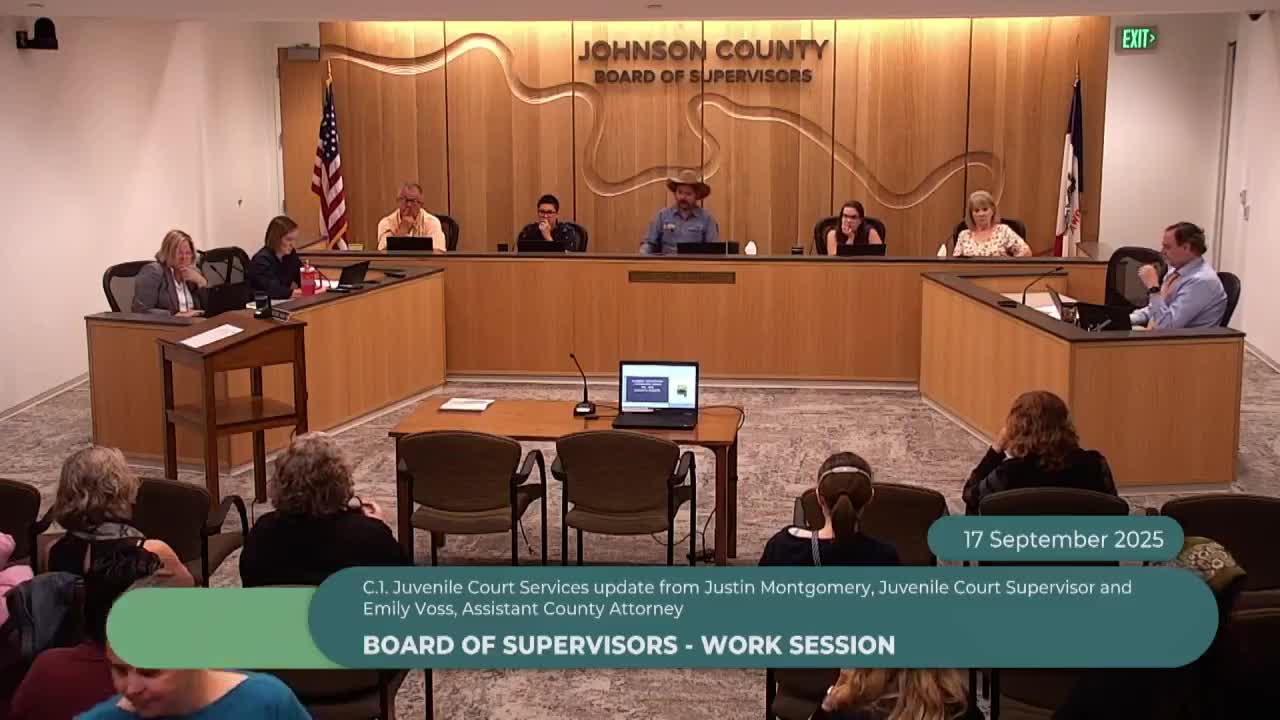
Justin Montgomery, juvenile court supervisor, and Emily Voss, assistant county attorney, told the Johnson County Board of Supervisors on Sept. 17 that most juvenile complaints are screened early and many are diverted before court while a minority proceed to formal petitioning. "Any young person under the age of 18 that is a resident of Johnson County that is charged with a simple misdemeanor is eligible for pre‑charge diversion," Montgomery said, describing three diversion “buckets” for substance, assault and other misdemeanors.
The supervisors were shown how pre‑charge diversion operates in practice: law enforcement or intake staff check eligibility and, if eligible, some juveniles are referred to community programs provided through UAY (United Action for Youth). "We offer that opportunity," Montgomery said. Emily Voss said the office tracked pre‑charge diversion counts through Oct. 25, 2024: 91 referrals that year, of which 42 were for shoplifting, 17 for substance issues and 22 in a miscellaneous category. Another program called Ladders accounted for 10 referrals in that dataset.
The presenters described a three‑tiered internal diversion tool (DVO 1–3) used when complaints arrive at the court office. DVO 1 typically produces a dismissal letter for a first simple misdemeanor; DVO 2 covers second simple misdemeanors and some first‑time assaults or possession; and DVO 3 may include an assessed intervention with a 60‑day completion window that intake staff monitor. "If they follow through, we close it successfully. If they don't follow through, we just close it unsuccessfully," Montgomery said.
Montgomery and Voss explained that about one third of juvenile complaints ultimately lead to court petitions, based on their review of filings. Petition counts recorded by the office over 25 years ranged from a high of 303 petitions in February 2007 to a low of 69 petitions in 2021; the office filed roughly 93 petitions in 2023 and about 125 last year. The presenters emphasized that all juveniles in court must have counsel and that most cases resolve through admissions rather than trial. "Probably 90% of our cases end up with admissions versus trials," Voss said. Judges may place juveniles on consent decrees or informal adjustments; the court can also issue no‑contact orders and safety assessments when necessary.
Supervisors pressed for additional data. Montgomery agreed to provide longitudinal diversion and referral numbers going back 10 years and suggested inviting Tony Branch from UAY for a future briefing to discuss community engagement features of diversion programming.
The presenters flagged several operational points for the board: the statewide Detention Screening and Tracking Tool (DSTT) is used by referring agencies and yields scores that recommend release or hold; the local juvenile court officer on call can override DSTT recommendations but a juvenile admitted to detention must still receive a detention hearing within 24 hours where the judge considers risk to self, community or victims; and certain charges (firearm use, district court offenses, school threats) routinely require court intake. Voss noted confidentiality rules in state law that generally keep juvenile records sealed unless adjudicated for a felony and outlined procedures for sealing records after successful completion of conditions.
Supervisors requested follow‑up information, including 10‑year trends on pre‑charge diversion referrals, and asked staff to return with additional data and invited diversion program partners to future meetings. The board did not take formal action on policy at this session.