Get Full Government Meeting Transcripts, Videos, & Alerts Forever!
Get email alerts on the Urban Renewal Tenant Improvement topic
No spam. Unsubscribe anytime.
Urban renewal staff propose tightening tenant‑improvement grant rules; board to review Oct. 15
Summary
URA staff presented proposed changes to the small-business tenant improvement (TI) grant program: split TI-specific guidelines from a flexible development-category, require landlord/tenant matching (proposed 50/50), and set a lower maximum grant cap; staff will return to the board Oct. 15 with revised guidelines.
Fairview Urban Renewal staff presented potential revisions to the agency’s tenant‑improvement (TI) grant program at the URA meeting held during the council session on Sept. 17. Staff summarized past awards, discussed program challenges and sought direction on several policy options including whether the URA should: (1) split TI grants from other flexible redevelopment categories, (2) require landlord/tenant matching contributions, (3) set a lower maximum grant cap, and (4) clarify eligibility for existing businesses and nonprofits.
Why it matters: The URA fund has been used to help convert vacant commercial spaces and support tenant buildouts; staff said the program’s broad eligible expenses and a maximum grant of up to $100,000 have created administration and equity questions. Several locally awarded grants were cited as precedent, including awards to restaurants, a studio and other businesses; URA staff said they paused the program at an Aug. 6 meeting to refine guidelines.
Key proposed changes presented Sept. 17: split the grant program into (A) a TI/vacant‑space category with streamlined rules and (B) a flexible redevelopment category for other barrier-removal projects; require city assistance not to exceed 50% of total project cost with the landlord/tenant providing the remainder; consider reducing the $100,000 maximum (board discussion suggested $50,000 as an option); and clarify whether existing businesses, nonprofit operators, and franchisees should be eligible and under what conditions.
Public comment and staff response: A local resident and stakeholder urged caution about lowering support levels because past applicants used larger awards and might be discouraged by a lower cap; staff said they would return with refined language that reflects the board’s priorities.
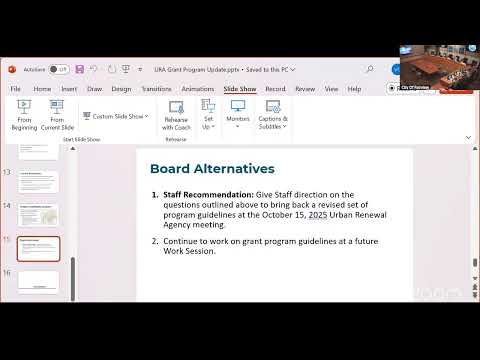
What’s next: Staff said they would bring proposed revised guidelines back to the URA board on Oct. 15 for adoption consideration. The URA will continue to accept feedback from businesses and landlords while drafting the revised program framework.