Get Full Government Meeting Transcripts, Videos, & Alerts Forever!
Get email alerts on the Economic Development topic
No spam. Unsubscribe anytime.
Fairview urban renewal staff propose tighter rules, landlord match and lower cap for business TI grants
Summary
Urban renewal staff on Wednesday recommended reworking Fairview’s tenant-improvement grant program to require landlord/tenant contribution, split the program into two focused tracks, and lower the routine maximum award so public funds are not the primary source for private building upgrades.
Fairview urban renewal staff presented proposed changes Wednesday to the city’s business tenant-improvement (TI) grant program, recommending clearer eligibility rules, a required applicant contribution and a lower standard maximum grant to make awards more targeted and avoid subsidizing routine building maintenance for property owners.
Staff and the Economic Development Advisory Committee (EDAC) recommended two separate program tracks: (1) a focused tenant-improvement grant for vacant commercial spaces that would help bring new businesses in and (2) a separate, flexible pool for other barrier-removal needs (environmental mitigation, demolition, block consolidation). Under staff’s draft approach the city would generally contribute up to 50% of a project’s cost with the landlord and tenant sharing the remaining 50% based on lease terms; EDAC and several landlords told staff they preferred a clear 50/50 expectation rather than allowing the city to pay a majority of costs.
Councilors and staff also discussed lowering the program’s maximum award. The current guidelines allow awards up to $100,000; several council members and EDAC members suggested a lower standard cap (examples discussed included $50,000), while reserving council discretion to approve larger awards in exceptional cases. Staff cautioned that a lower cap could affect applicants similar to those previously funded (examples cited included Stomping Grounds and Crescent Studios) and urged careful design of transition rules.
On eligibility, staff proposed keeping franchise and adult-only businesses excluded but suggested allowing small local franchises and reconsidering nonprofit eligibility in narrow, mission-driven cases (for example, an adult day program that would increase local services). Staff recommended making the program explicitly available to existing businesses when the investment demonstrably increases capacity, jobs or customer-serving frontage.
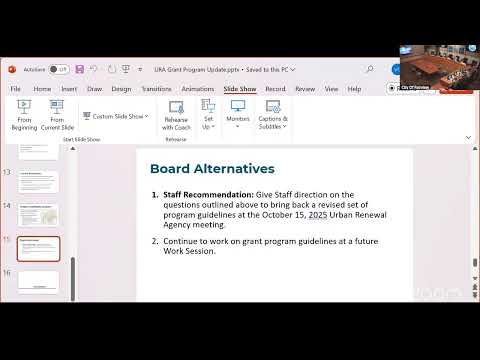
Staff said it would return on Oct. 15 with revised program language incorporating council feedback. The urban renewal board will not re-launch awards until new guidelines are finalized.