Get Full Government Meeting Transcripts, Videos, & Alerts Forever!
Get email alerts on the Economic Development Finance topic
No spam. Unsubscribe anytime.
Bloomington reviews Mall of America water park financing, public subsidy terms
Summary
At a joint study session, city and port staff reviewed the proposed Mall of America water park — a 220,000-square-foot, $432 million project — outlining public and private financing, guarantees provided by the developer and risks and next steps for approvals.
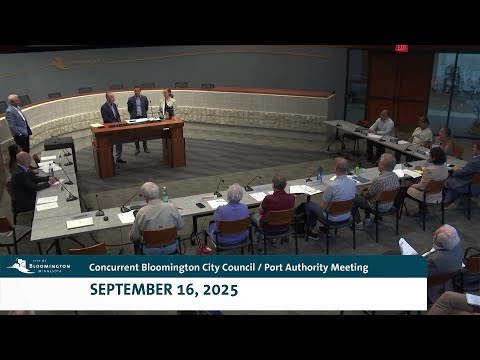
Holly Masic, Port Authority administrator for the City of Bloomington, told the joint study session that city and port staff were presenting an update on Mall of America’s proposed water park and its financing, including public subsidies already embodied in an April 2024 term sheet and private loan term sheets the developer has obtained. "This has been in discussion in earnest since about 2018," Masic said.
The proposed facility would occupy a 220,000-square-foot building with about 144,000 square feet of pool hall containing one wave pool, a lazy river and roughly 30 water features and slides. Project cost was described in the presentation as approximately $432,000,000; staff said the public contribution in the term sheet totals $160,000,000 of tax increment financing (TIF), composed of an $85,000,000 spending-plan TIF allocation and up to $75,000,000 of regular TIF for parking and public improvements.
Kevin Knaise, assistant Port Authority administrator, and developer representatives outlined the private financing. Staff said the developer has a construction loan term sheet with Infinite Global Real Estate Partners for roughly $120,000,000 at an estimated 14.27% interest rate and a CPACE (Commercial Property Assessed Clean Energy) term sheet for about $133,000,000 at an estimated 7.43% rate; staff characterized the blended cost of capital at about 10%.
Curt (Kurt) Hagen, senior vice president of development for Mall of America/Triple Five, and Martin Walrath, executive vice president for corporate finance, described market support for the project and the developer’s guarantees. Hagen said the water park is expected to drive tourism and hotel stays and cited an estimate of about 700,000 annual guests, approximately 40% of whom would be overnight visitors. "That will generate about 90,000 hotel room nights a year," he said, and the project would produce new local and regional tax revenue, staff said.
Developer guarantees described in the meeting include about $20,000,000 of cash or liquid collateral, a $22,500,000 principal repayment guarantee, and completion and interest-carry guarantees from the project ownership. Staff and Mall of America representatives said those guarantees reduce risk to the public financing by providing additional recovery before public funds would be exposed.
Staff emphasized the special nature of the public funding: the primary public source is tax increment generated by Mall of America property. Holly Masic said state legislation enabled the city to designate a portion of that TIF as a spending-plan TIF (previously approved as a COVID-19 economic relief tool), allowing the city to invest those regional tax increments directly into a private project rather than only into public improvements. Kevin Knaise said the legislature extended the spending-plan TIF deadline to allow use of the funds through 2027.
City staff presented anticipated economic impacts and risks. Staff estimated additional first-year city receipts including about $1,100,000 in admissions tax, $45,000 in liquor tax, approximately $2,750,000 in property taxes (about $450,000 to the city general fund), and roughly $329,000 in new lodging tax; staff summarized the total additional city tax revenue at about $1,800,000 annually and estimated roughly $3.5 million in new local taxes when broader local-option and lodging taxes are included. Hagen and staff said the mall historically contributes roughly 11–12% of Bloomington’s general fund revenue and that the project could help diversify the mall’s mix of retail and experiential uses.
Risks identified in the session included higher-than-expected construction costs, continued uncertainty in credit markets and interest rates, the timing of deferred private equity injections required under the deal structure, and potential loss of pursuit spending (about $6,500,000) if construction does not start. Staff noted that if the project were sold or foreclosed and a new owner took over operations, the city would still realize many near-term benefits (construction jobs, tourism) though the planned cash-flow recapture mechanism for future reinvestment could be altered.
No redevelopment agreement or release of pursuit funds was approved at the study session. Staff told the joint bodies they expect to return at a concurrent meeting on September 30 to consider (1) a redevelopment agreement (if finalized), (2) release of $6,500,000 in pursuit spending, (3) approval of an amendment extending the spending-plan TIF deadline, and (4) up to $1,000,000 of regular TIF for public-improvement design work. Holly Masic said the redevelopment agreement had not been finalized and would be provided to commissioners and council members before any vote.
Council and commissioners asked for additional detail on sources of TIF revenues (including fiscal-disparities components), the precise nature and convertibility of collateral and guarantees, and the terms of a potential sale-leaseback. Martin Walrath said there is $20,000,000 of liquid collateral that lenders could convert to cash and described personal and corporate completion and repayment guarantees from the project owners and principals. Council and port members requested staff follow up with documentation on the guarantees and any cross-collateralization before final approvals.
The session ended without substantive votes on the project; the council adjourned by a 5–0 motion. Staff will bring requested clarifications and the redevelopment agreement back to the joint bodies at a future meeting for formal action.