Get Full Government Meeting Transcripts, Videos, & Alerts Forever!
Get email alerts on the Mental Health Funding topic
No spam. Unsubscribe anytime.
Commissioners earmark remaining behavioral-health tax funds for jail medical costs through 2027
Summary
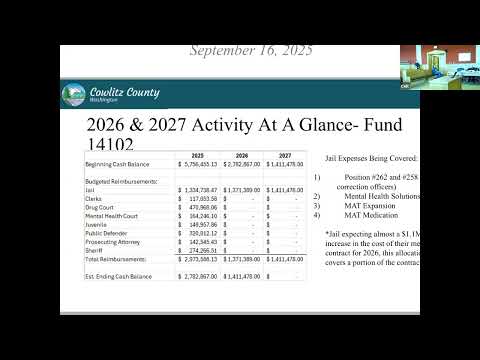
Kathy Funk Baxter, finance director, told the Board of County Commissioners the county expects about $2,700,000 in residual proceeds from a behavioral‑mental health sales tax that has since sunset.
Kathy Funk Baxter, finance director, told the Board of County Commissioners the county expects about $2,700,000 in residual proceeds from a behavioral‑mental health sales tax that has since sunset. "we're projecting that at the 2025, we will have about $2,700,000 left residual from the that tax," she said, and that amount "is not sufficient to continue a full year of funding for all of the…previous departments that had been funded from this tax." The finance director recommended earmarking the remaining funds to supplement the jail’s medical contract and related jail behavioral‑health services for 2026 and 2027 so the county can fully expend the residual funds within that period. "If we were to expend the funds [on] the jail for those purposes, we will completely exhaust these funds at the 2027," Baxter said. The jail’s medical contract alone is described in the meeting as being “well over $2,000,000,” and Baxter said the residual funds would only cover part of that contract and associated items (two correctional officers, MAT expansion and medication). Sheriff Brad Thurman, who attended the discussion, said the sheriff’s behavioral‑health unit currently has two staff after an earlier four‑person model was reduced for attrition and evaluation; he said maintaining the two positions will cost roughly $254,000 per year. "Originally, when we started this up back in 2023, we actually funded 4 people out of the program…due to attrition and evaluating the program, we dropped it down to 2 folks," Thurman said. Finance staff listed other departments that previously received tax funding: the clerk’s office (one position), drug court (about $470,000, primarily personnel), mental‑health court ($164,000), juvenile services ($148,000), the public defender’s office and the prosecuting attorney’s office (each shown as pieces of multiple positions), and two sheriff’s office positions tied to behavioral health. Baxter said some departments have already collapsed vacant positions to preserve roles formerly paid from the tax; she said the clerk’s office and juvenile department used that approach and thereby reduced the projected general‑fund impact. Departments that want to continue positions funded by the expired tax will be asked to present personnel requests and budget justifications in upcoming budget hearings (personnel hearings on October 7 and departmental budget presentations later), Baxter said. Commissioners pressed staff for more granular detail about which positions and functions would be affected, whether work currently paid from the tax is legally mandated, and whether duties would cease if funding ends. Baxter said the county’s only clear obligation is to provide medical services for the jail; other uses had been established during the life of the tax by an earlier allocation process that assigned fractional FTE funding across multiple offices. Several commissioners asked whether programs (for example drug court) would be able to function without certain positions; Dallas, manager for therapeutic courts, explained that drug court, mental‑health court and related specialty dockets are multidisciplinary and require attorneys, judges and staff on the team to operate. Dallas said eligibility and referral occur after arrest and that the programs are designed to provide treatment options tied to legal intervention. The board did not take a formal vote during the workshop. Baxter said the working recommendation for the budget draft is to reserve the remaining behavioral‑health tax funds to supplement jail medical services for 2026–27 and to allow other departments to seek general‑fund support if they choose; she emphasized departments will have at least two opportunities to present justification to retain staff currently paid in part from the sunset tax. Ending: Commissioners directed staff to include the jail allocation in the draft biennial budget and to return with more detailed personnel spreadsheets and departmental justifications at the personnel and budget hearings scheduled later in the process.