Get Full Government Meeting Transcripts, Videos, & Alerts Forever!
Get email alerts on the Business Licensing topic
No spam. Unsubscribe anytime.
Committee recommends calendar-year food-truck licenses, raises payday-lender fee
Summary
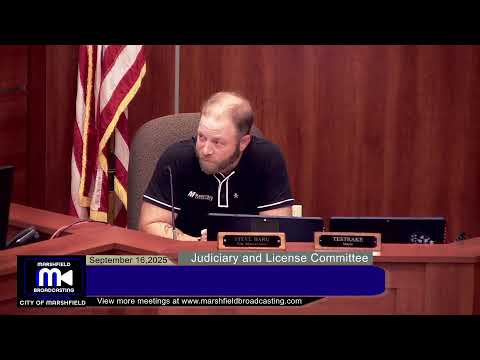
The Marshfield Judiciary and Licensing Committee on Sept. 16 recommended changing the city’s food‑truck licensing period to a calendar year and increasing the annual license fee, and it approved a separate increase to the payday‑lender application fee.
The Marshfield Judiciary and Licensing Committee on Sept. 16 recommended changing the city’s food‑truck licensing period to a calendar year and increasing the annual license fee, and it approved a separate increase to the payday‑lender application fee.
Committee members discussed a proposed shift that would move food‑truck permits from the current July 1–June 30 fiscal year to a January 1–December 31 calendar year, with an annual fee set at $100 beginning Jan. 1, 2027, and a transitional six‑month permit from July 1, 2026, through Dec. 31, 2026, charged $25.
The proposal came after Jessica, a staff member, presented a fee‑schedule spreadsheet comparing Marshfield’s existing charges with those used by Stevens Point, Wisconsin Rapids and Wausau and explained the current permit structure. "Right now, we are currently charging them $25 for an entire year," Jessica said, describing the current food‑truck charge and noting that the permit period was set when food trucks were less common.
Mister Grama, a committee member, said he had no objection to switching to a calendar year but wanted the annual fee to be $100 to better align with neighboring cities and to reflect staff time. "I I I have no issue moving to a yearly license, but I would like to see the fee for the year go to a $100 to be more in line with Wisconsin Rapids and Wausau, especially when you consider it's an hour of time with the clerk's office to deal with this," Grama said.
Committee members debated transitional charges for 2026 because many current permits remain valid through June 30, 2026. After discussion and concern about a large one‑time jump for operators who would pay for overlapping periods, the committee approved a motion to set the 2027 annual fee at $100 and to charge $25 for the transitional July–Dec. 2026 period. The motion was moved by Mister Grama and seconded by Miss Spieros; the committee voted in favor and the motion carried.
Separately during the fee‑schedule review, a committee member moved to raise the one‑time payday‑lender application fee from $50 to $200. Miss Spiroz made the motion to increase the payday‑lender fee to $200; Mister Grama seconded. The motion carried.
Jessica told the committee she had left the payday‑lender entry marked with a question mark in the comparables because the city has not issued that license in about a decade and staff would need additional research to confirm statutory and local requirements.
Both changes are recommendations from the Judiciary and Licensing Committee; the clerk said a comprehensive resolution updating the full 2026 fee schedule will be forwarded to the finance committee and then to the full council. The food‑truck timing change will require a municipal‑code amendment, which staff said it will draft if the committee’s recommendation is approved by higher bodies.
Actions recorded at the meeting show the committee approved the transition and fee levels and the payday‑lender fee increase; those motions will be included in the packet sent forward for formal ordinance and resolution drafting.