Get Full Government Meeting Transcripts, Videos, & Alerts Forever!
Get email alerts on the Annexation Land Use topic
No spam. Unsubscribe anytime.
Gulf County explores buying 2.5-acre parcel after property owner says she was told site could be used for workforce housing
Summary
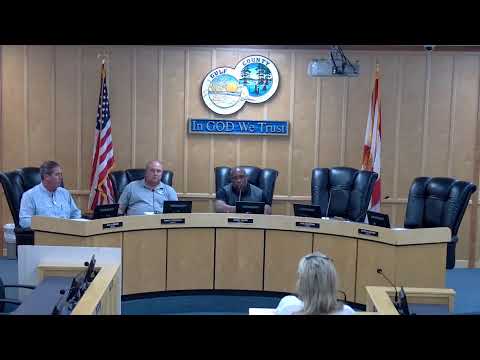
Gulf County officials said at a reconvened conflict-assessment meeting that they will pursue an appraisal and may offer to buy a 2.5-acre parcel owned by Kaye Haddock to resolve a dispute over the property's annexation and land use.
Gulf County officials said at a reconvened conflict-assessment meeting that they will pursue an appraisal and may offer to buy a 2.5-acre parcel owned by Kaye Haddock to resolve a dispute over the property's annexation and land use.
The county and the City of Port St. Joe are in conflict over the parcel after the city adopted a voluntary annexation and land-use change ordinances in August. Gulf County adopted opposing resolutions and initiated a conflict assessment under state law; the county’s attorney said the county has also filed court actions challenging the annexation and its effects. "We've already filed 2 lawsuits. They're sitting in the court system. It's in a declaratory action and injunctive relief, and we also have a writ for certiorari challenging the voluntary annexation," the county attorney said during the meeting.
The dispute centers on whether the parcel—now annexed into the city and rezoned R-3—was reasonably represented to Haddock as mixed-use commercial and suitable for workforce housing when she purchased it. Haddock told commissioners she met repeatedly with county planning staff in 2022 during her due diligence and was shown maps that she said identified the site as mixed-use commercial. "I bought this property with that intent," Haddock said, describing plans to build housing for employees. She said she spent about $45,000 clearing the site and that she paid "$242.40 for 2.5 acres" as part of the purchase process, and asked the county to obtain a commercial appraisal if it wishes to buy the land.
County officials said their long-term planning documents and the county comprehensive plan designate the broader area as industrial, and that the county has been treating the wider tract as industrial for decades. The county attorney said the core question for the record is when, if ever, the parcel’s designation formally changed in county public records: "The only way I can find that is when you examine and search a property, you go back over the last hundred years and you find out the day, the book, the page when it was done." County leaders said they will search public records and will ask commissioners whether to proceed with an appraisal and possible purchase.
Participants discussed alternatives that had been floated earlier, including a city-to-owner land swap of identified acreage intended for workforce housing and public-private partnership structures; city officials said the city lacks additional buildable acreage to offer and noted legal limits on conveying public property to private individuals. One city representative said, as summarized in earlier email exchanges, that "there's not any more property out there that's buildable" and that a private owner would need to form a nonprofit to participate in some partnership variations.
Haddock said she remains willing to sell the parcel at market value if the county will buy it: "I will entertain the idea if the county wants to buy this property for me at a fair market value price. If you wanna get an appraisal and then we can talk about it once we see what that looks like." County counsel said typical county purchases are contingent on a commercial appraisal and that the commission would need to approve any purchase contract.
No final agreement was reached at the meeting. County officials said that if the parties do not negotiate a sale, they will proceed to mediation required by the conflict-assessment statute and continue the pending court actions. The county attorney also advised that mediation discussions would be privileged and occur outside public meetings, and that the county would report back to the full commission and seek direction before making an offer.
Discussion at the meeting included community impact claims from both sides. Haddock and several speakers described local workforce housing shortages and said the parcel’s proximity to Highway 98 and nearby employers made it suitable for housing for lower-rent workers; county officials and commissioners emphasized the county’s economic development strategy and the need for a contiguous industrial area to attract employers. One county official described the stakes for the county as substantial, referencing proposed projects in the area including a maritime academy and a floating dry dock; that official said preserving industrial designations for the larger tract is important for those planned investments.
The county said the constructive next steps are to (1) verify public-record history for the parcel’s land-use designation; (2) obtain a commercial appraisal if the commission instructs staff to proceed; (3) make a purchase offer to the owner if the commission approves; and (4) if negotiations fail, proceed to mediation and litigation steps already underway. The meeting concluded with the county attorney saying he would notice mediation if needed and report back to the commission.
Discussion versus decision: the meeting produced discussion and a directive to explore appraisal and purchase options, but there was no final purchase decision or vote recorded at this meeting.