Get Full Government Meeting Transcripts, Videos, & Alerts Forever!
Get email alerts on the Housing Rent Stabilization topic
No spam. Unsubscribe anytime.
Fortuna council opens rent‑stabilization study; directs staff to draft temporary moratorium
Summary
After a lengthy study session and extensive public comment from mobile‑home residents, the Fortuna City Council directed staff to return with a proposed citywide temporary moratorium on mobile‑home rent increases and to research rent‑stabilization options, including MOUs and ordinances.
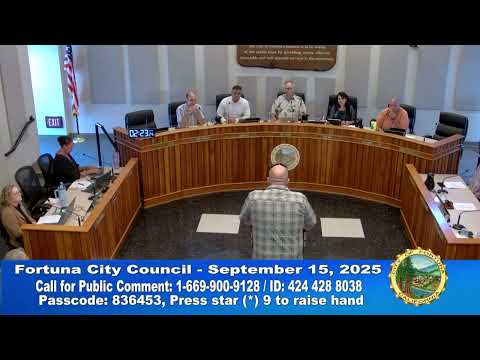
Fortuna City Council opened a study session Tuesday on mobile‑home space rent stabilization and, after extended public comment, directed staff to prepare a citywide temporary moratorium on mobile‑home rent increases and to return with legal analysis and options for a permanent response.
City staff reviewed the legal framework and policy options, telling the council that California’s Mobile Home Residency Law requires 90 days’ notice for rent increases and identifies lease‑termination grounds but does not preempt local rent regulation for spaces rented before Jan. 1, 1990. Staff said Fortuna contains four mobile home parks with roughly 283 spaces and that nearly 100 jurisdictions in California have mobile‑home RSOs; Arcadia and Humboldt County were cited as examples of different approaches.
Staff presented five options: take no action; negotiate a memorandum of understanding (MOU) with a park owner; create a city or nonprofit‑run rent conciliation/mediation service; require reporting for rent increases that exceed CPI; or adopt a formal rent‑stabilization ordinance (RSO) limiting increases, typically to a CPI tie and providing vacancy and petition mechanisms. The staff report highlighted risks and tradeoffs, including legal exposure and the cost of administering an RSO. The presentation noted Royal Crest Mobile Home Park had seen cumulative non‑view rent increases that average roughly $31 per year (5.34% annually) from 2012 to 2025, with cumulative increases of about $822 in 2025 compared with $419 in 2012 for certain lot types.
More than two dozen residents and advocates spoke during public comment. Cecilia Holland, a 50‑year Fortuna resident, urged an RSO and described mediation and conciliation as “voluntary processes which work when both sides have equal power. This is not the case in a tenant‑landlord situation.” Hillary Mosier, regional manager for the Golden State Manufactured Homeowners League and author of Humboldt County’s RSO, warned that MOUs “require tons of staff time, allow for amendments at any time, and include no inherent enforcement or penalties for violation.” Residents described steep, recurring increases, loss of home equity and limited relocation options for older mobile homes.
Council members expressed concern about risks and costs to the city from litigation and long‑term administration. Several said they favored trying to secure tenant protections without exposing the city to unsustainable legal or staffing costs. After discussion, a council member moved and the council voted unanimously to direct staff to return at the earliest convenience with a draft emergency moratorium on mobile‑home rent increases and to collect legal case studies and cost estimates that would inform longer‑term options including an RSO or an MOU.
City staff said the moratorium could be developed relatively quickly but would require city‑attorney review and collaboration with outside counsel experienced in rent‑stabilization law. The council also asked staff to compile comparative case law and examples (Humboldt County RSO, Arcadia ordinance and Rancho Cordova MOU were referenced) and clarify administrative costs, potential fees per space, and enforcement mechanisms. Council did not adopt a permanent ordinance or MOU at the meeting.