Get Full Government Meeting Transcripts, Videos, & Alerts Forever!
Get email alerts on the Municipal Finance Infrastructure topic
No spam. Unsubscribe anytime.
Sanger officials tell state rep bonding limits could hinder water, wastewater projects
Summary
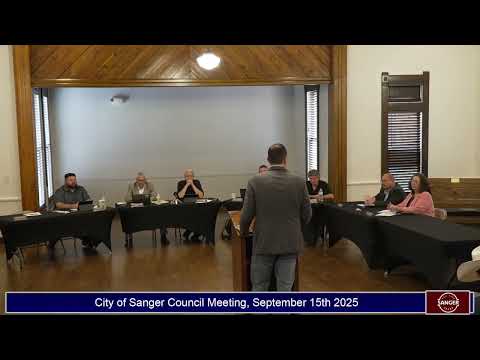
At a Sept. 15 Sanger City Council meeting, Representative Jared Patterson discussed state legislative attention to property tax and bonding limits and council members raised concerns that restrictions could constrain the city’s ability to finance large utility projects, notably a new wastewater plant and water-supply work tied to Lake Ralph Hall.
Representative Jared Patterson and Sanger officials discussed at the Sept. 15 council meeting how proposed state-level restrictions on municipal bonding and other legislative actions could limit the city’s ability to finance major infrastructure. Council members said the town faces large upcoming costs for utilities, notably a planned new wastewater treatment plant, and warned that constraints on bonding could force difficult trade-offs.
The conversation began when Mayor Thomas Muir introduced Representative Jared Patterson to give a legislative update. Patterson said, “property tax is an easy win with the taxpayer,” and described a broader legislative focus that could include limits on municipal bonding and bonding flexibility. Patterson told the council that restrictions on bonding and other measures under consideration at the statehouse could affect how small and mid-sized cities plan and pay for fixed infrastructure needs.
Why it matters: Council members said their principal concerns are funding for large, non-discretionary capital projects — wastewater treatment, streets and public safety facilities — that cannot be deferred. Mayor Thomas Muir noted the city will need “a whole new plant” for wastewater in the coming years and said limits on bonding “begin to get concerned” for towns that rely on bonds to fund such projects. Council members said Sanger remains heavily reliant on property tax and has a smaller sales tax base compared with larger cities, limiting other local financing options.
Council discussion and examples Representative Patterson described the political context at the Capitol, saying there has been an “attack on bonding capability and limitations,” and that much of municipal capital work is financed by bond issuance. Mayor Thomas Muir and council members asked whether the legislature’s posture would continue and whether the city should take proactive steps to manage perceptions and prepare financially.
Council members also raised concerns about so-called “package plants” used in some subdivisions. One council member warned that cluster or package wastewater plants placed in small developments could deteriorate over time and later impose high assessment or replacement costs on residents. Muir said: “I have fear that, like, the package plants... in 20 years, I think there's a problem,” adding that the cost to replace or upgrade those systems could saddle homeowners.
Water supply and regulation Patterson and the council also discussed regional water projects. Patterson noted Sanger’s membership in the Upper Trinity Regional Water District and the long lead times for projects such as Lake Ralph Hall. He said those projects can take decades and that permitting and regulatory processes — including at the Texas Commission on Environmental Quality and federal agencies such as the EPA — affect how quickly water infrastructure can come online. Patterson said speeding regulatory steps and ensuring adequate compensation for landowners are part of meeting rapid growth in demand.
What was not decided No formal council action resulted from the legislative update. The discussion was an information exchange: council members asked questions about likely legislative directions and about what the city can do to prepare. There was no motion, vote, or direction recorded to change city policy or to adopt specific financing measures during the meeting.
Context and next steps Council members referenced the city’s comprehensive planning work (a “2040 plan”) that calls for lower-density and estate-style lot options at the city edge, and said their ability to shape future development is constrained by limited regulatory and financial tools and by developer economics. Several council members asked Patterson for ongoing communication with lawmakers; Patterson thanked the council for the discussion and the meeting concluded without formal action tied to the update.