Get Full Government Meeting Transcripts, Videos, & Alerts Forever!
Get email alerts on the Fire Code Wui topic
No spam. Unsubscribe anytime.
Calamasa council adopts state-required wildland‑urban interface and fire code updates under urgency ordinance
Summary
The City Council approved an urgency ordinance adopting the 2025 California Wildland‑Urban Interface (WUI) code and related 2025 California Fire Code provisions, with staff noting the changes respond to a state mandate and carry implications for new construction, defensible space and insurance.
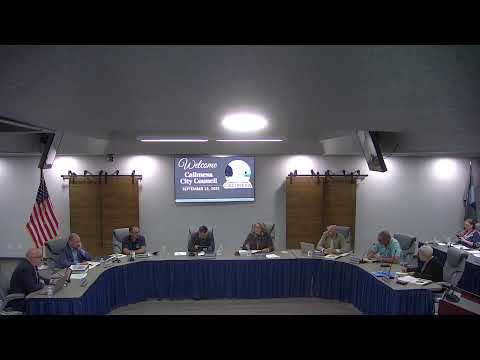
The Calamasa City Council on Sept. 15 adopted an urgency ordinance to incorporate the state'025 California Wildland‑Urban Interface (WUI) code and 2025 California Fire Code provisions into the municipal code and set a public hearing for the regular ordinance's second reading on Oct. 6, 2025. The council approved both the urgency ordinance (No. 4-16U) and the corresponding regular ordinance (No. 4-16).
City staff said the adoption is driven by state law and a Sept. 30 deadline that would otherwise leave the city operating under older code editions. Building Official Dave Fred Borg and fire staff briefed the council on changes that apply to new construction and to certain renovation thresholds; Deputy Chief (Fire Prevention) Shaw and Ron Graeter of Charles Abbott answered technical questions on defensible space, ignition‑resistant construction and inspection procedures.
City staff and consultants explained why the city pursued an urgency ordinance. City Manager Cobol told the council the urgency measure is needed so the city is not left on an older code and to avoid disruptions to insurance and state compliance. Graeter said the state updated fire hazard maps and the WUI code that expands requirements for defensible space and ignition‑resistant construction around structures.
Council members pressed staff on homeowner impacts. Council Member Manley said he found the 0‑to‑5‑foot defensible‑space prescription especially difficult for existing properties: "I think it's a terrible ordinance," he said, adding concerns that retrofit costs could leave homeowners unable to recover insurance claims after a fire. Staff and Chief Shaw responded that the new rules apply broadly to new construction and to major alterations, and that defensible‑space inspections are required during real‑estate transactions under state law. Chief Shaw and Graeter emphasized that many requirements are framed as "ignition‑resistant" construction standards rather than an absolute ban on combustible materials.
Staff described practical effects and timing. The building official said projects are subject to the code edition in effect when permits are pulled; staff said cities typically allow a limited grace period for plan proponents to pull permits under the prior code. Staff also told the council that adopting the state code is tied to maintaining the city's current ISO rating, which affects homeowner insurance rates: remaining on an older code in the past had contributed to a higher ISO rating and higher premiums.
The council approved the urgency ordinance with the city attorney's recommended wording that the ordinance itself take effect immediately while the substantive code provisions would not be enforced before Jan. 1, 2026, the start date for the state edition. Council Member Manley moved approval of the urgency ordinance and Council Member Cundiff seconded it; the council adopted the urgency ordinance and then separately approved the regular ordinance and set the second reading/public hearing for Oct. 6, 2025.
The council and staff repeatedly described the adoption as compelled by state law (including a referenced assembly bill discussed at the meeting) and as the minimum required action; they removed several local amendments where the state WUI code already addressed the topics.
What happens next: staff will publish the regular ordinance for second reading and hold the public hearing Oct. 6, 2025. Staff said enforcement of the substantive code provisions will align with the state's effective date for the 2025 edition (no sooner than Jan. 1, 2026). Residents with questions about how the rules affect existing homes and pending projects were directed to the building and fire prevention offices for case‑specific guidance.
Ending: The council voted to adopt the urgency ordinance and the regular ordinance (second reading scheduled), and staff said they will return with the standard public‑hearing process and informational materials for homeowners and builders.