Get Full Government Meeting Transcripts, Videos, & Alerts Forever!
Get email alerts on the Homelessness Planning Montgomery County topic
No spam. Unsubscribe anytime.
Montgomery County launches rapid planning process to prioritize homelessness prevention and rehousing
Summary
A consultant and Home Solutions staff outlined a fast-track public input process, seven opportunity briefs and a timeline aiming for recommendations in January and implementation in early 2026.
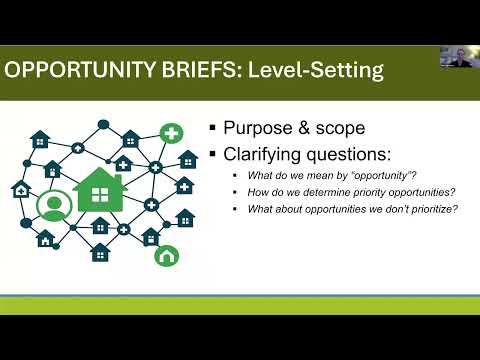
Tom, a consultant working with Home Solutions and Montgomery County, told a webinar audience that the county will run a fast-paced planning process to identify priority actions to prevent and reduce homelessness and move toward implementation in early 2026. The process centers on seven short “opportunity” briefs and a 30-day input window, Tom said.
The effort seeks to build prevention, speed rehousing and strengthen system coordination so homelessness is “brief and rare,” Tom said. He described the briefs as concise, curated summaries of promising strategies drawn from national, state and local examples, and said the team borrowed a graphic from the Canadian Observatory on Homelessness (Homeless Hub) to show the overall goal of rebalancing crisis response toward prevention.
Why it matters: the planning work will steer short-term priorities and potential funding or program efforts that Montgomery County’s Homeless Solutions Policy Board and the local Continuum of Care (CoC) may consider for adoption and implementation in 2026. Because the team is aiming to move quickly, input collected in the coming weeks will shape the feasibility review and the recommendations presented to decision-makers.
Key elements of the process outlined on the webinar: • Opportunity briefs: seven topic areas distilled into single-page digests and separate documents for targeted review. The briefs cover coordinated access/coordinated entry, landlord engagement, street outreach, emergency and transitional shelter, permanent supportive housing, rapid rehousing and CoC governance improvement. • Input methods and timeline: interviews and focus groups with stakeholders (including people with lived experience and frontline staff), plus a brief public survey. The survey and interviews will be open through Friday, Oct. 3, with focus-group activity scheduled in the weeks after the webinar. • Feasibility and decision schedule: staff will analyze input, then evaluate top priorities’ cost, near-term steps and feasibility; draft recommendations will go to the Homeless Solutions Policy Board and the CoC for review in November, with final recommendations returned in January and an intention to begin implementation in the first quarter of 2026 if priorities are adopted.
Tom emphasized the team’s approach to collecting uncolored input: “We don't want to color your input,” he said, adding that the process is designed to “get as much input as possible” from a wide range of stakeholders. He also framed the objective in operational terms: “We're aiming for velocity,” meaning the team wants both quicker prevention and faster rehousing pathways.
Home Solutions staff were identified as conveners of the process and are hosting the briefs and survey on the Home Solutions website. Participants were asked to review the briefs before taking the survey; the consultant said briefs are intentionally concise, not comprehensive, and are meant to prompt feedback and local additions. The webinar host encouraged attendees to share the link with other community partners.
Discussion vs. decision: the webinar was a planning and outreach briefing, not a decision-making meeting. No motions or formal votes occurred. The consultant described intended next steps — interviews, focus groups, feasibility analysis and board presentations — but did not announce any adopted policies or funding allocations.
The presenters said they intend to hear widely from organizations and individuals across the system, from cross-sector partners and funders to frontline workers and people with lived experience, to surface practical opportunities the county can pursue rapidly. The consultant urged participants to consider ambitious but actionable changes, noting the work will require “extraordinary” effort beyond day-to-day responsibilities.
The county’s next milestones, as stated on the webinar, are the close of the input period on Oct. 3, a feasibility phase and draft recommendations to the policy board and CoC in November, finalized recommendations in January and an aim to start implementation in the first quarter of 2026.