Get Full Government Meeting Transcripts, Videos, & Alerts Forever!
Get email alerts on the Community Referendum Survey topic
No spam. Unsubscribe anytime.
Board reviews draft community survey for possible funding referendum, prioritizes safety and asks for more precise tax numbers
Summary
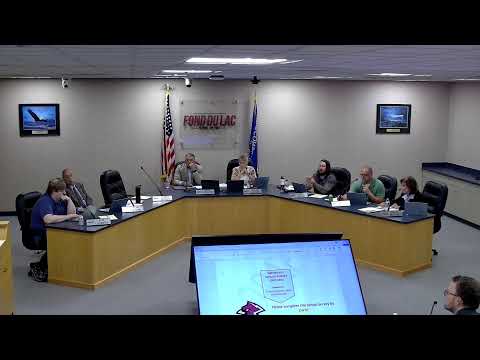
Fond du Lac — The Board of Education spent more than an hour on Oct. 5 reviewing a draft community survey that would gauge support for a possible referendum to address a projected multi‑year operating shortfall and funding priorities such as high‑school security upgrades and reducing class sizes.
Fond du Lac — The Board of Education spent more than an hour on Oct. 5 reviewing a draft community survey that would gauge support for a possible referendum to address a projected multi‑year operating shortfall and funding priorities such as high‑school security upgrades and reducing class sizes.
The draft survey, prepared by consultant Bill Foster of School Perceptions, asks whether voters would support a roughly $6 million operational referendum (spread over four years in the draft) to maintain academic programs and class sizes, preserve mental‑health services, and pay for building maintenance. Foster told trustees, “Survey can’t be a marketing tool,” and urged brevity and clear, factual wording so the results reflect community priorities rather than persuasion.
Why it matters: Board members said the district faces a structural funding gap because state aid and revenue limits have not kept pace with inflation and because enrollment has declined. Trustees said the survey will shape whether the district pursues an operational referendum, a capital referendum (bonding) or a different mix of projects — and which specific projects taxpayers would support.
Most important facts - Consultant recommendation and format: Foster recommended a short, mail‑and‑web survey (8 panels printed front/back) with an FAQ to hold more technical detail. He warned each additional 100 words in a survey can reduce response rate about 1 percentage point and recommended a target length of roughly 1,400–1,800 words. - Two draft funding approaches discussed: (1) a single “base plan” operational ask the board proposes (roughly $6 million over four years in the draft) with yes/no support; or (2) a bucketized/tax‑tolerance approach that presents multiple project “buckets” (for example, safety, class‑size reduction, technology) and asks respondents how much they would be willing to support overall and by bucket. - Safety vs. operations: Several trustees urged elevating security upgrades at Fond du Lac High School and districtwide cameras/locks above the class‑size/operational items. One trustee, Joan, described the high school as “vulnerable” and said, “This is an accident waiting to happen,” arguing safety should not be an add‑on. Others said both safety and maintaining classroom programs are important and the survey should let voters indicate priorities. - Cost examples in the draft: the consultant showed a sample mill‑rate impact that would move the district mill rate in year one from about $5.46 to about $6.54 with declining impacts in subsequent years (draft figures included $6.10, $5.57 and $5.37 in later years). Foster cautioned those are preliminary estimates and will change when the district gets the official fall state aid numbers (the consultant recommended waiting until after the state posts the October calculations to finalize tax‑impact figures). - Additional clarifications requested by trustees: add clearer language on why the district needs funds (state funding caps/revenue limits and declining enrollment), explain that special education is federally mandated (IEP obligations) and provide FAQ line‑items (for example, estimated costs for reconfiguring the high‑school entrance, cameras, and smart locks) for residents who want detail.
Discussion and direction Trustees debated both substance and presentation. Points raised included: - Whether security projects should be funded through an operational referendum or a capital/bond referendum (board members were told both financing routes are possible but that ballot timing and statutory limits make the options different and potentially constraining). - How to describe past referendums: the survey must distinguish the 2018 capital referendum (facilities funding) from the April operational referendum that voters rejected; the consultant suggested clear, simple language explaining that capital money cannot be used for day‑to‑day operations. - Special education cost context: trustees asked for a short FAQ explanation that services are mandated and some individual student costs can be very high; the consultant and staff agreed to add mandated IEP information and approximate special‑education spending totals. - Outreach and access: trustees asked that surveys be accessible (paper reply envelope included, online unique alphanumeric codes to prevent duplicate responses, and Spanish and other language support available on request). Trustees also suggested placing on‑demand translated paper surveys at schools serving large non‑English populations.
Decisions and next steps - Timing: The board agreed unanimously to slow the timetable to allow the district to use updated fall state aid/mill‑rate figures. Trustees directed staff and the consultant to revise the survey wording and append an FAQ; aim to mail surveys in early November with a return deadline before Thanksgiving and to present preliminary results at the board’s December meeting. - Survey structure: Trustees asked the consultant to produce a revised draft that elevates safety/security in the presentation (either by moving that bucket ahead of class‑size language or by making safety a standalone bucket) while still testing support for a base operational ask. They also asked for a standalone question set (or “buckets”) giving respondents the ability to indicate support for safety, class‑size changes, and other categories separately. - Public events and contact: the board agreed to include FAQ and event dates in the mailed material (the consultant suggested scheduling informational sessions while the survey is open). Trustees asked that one district contact (the superintendent’s office) handle incoming requests for additional paper surveys or questions rather than listing multiple board‑member emails.
Formal action The only formal recorded vote at the workshop was the motion to adjourn. Trustees moved and seconded adjournment; the roll call showed the motion carried 7–0. Other items discussed produced board direction to staff and the consultant but no formal referendum resolution at this meeting.
Background and context Board members and the consultant repeatedly noted that declining enrollment (the district serves several hundred fewer students than it did 15 years ago) and long‑standing state revenue limits have put pressure on operations. The draft survey is intended to give trustees the information needed — before any resolution is drafted — about which funding approach and which spending priorities the community would support.
What to watch for next - A revised draft survey from School Perceptions reflecting the edits discussed at the workshop (FAQ added, safety moved up, clearer cost language) and an updated set of tax‑impact figures produced after the state posts October aid/mill data. - Community information sessions and a mailing that include an FAQ and a single contact method for residents who need paper or translated surveys.
Reporting note: This article is based on a board workshop presentation by consultant Bill Foster (School Perceptions) and on statements during the public workshop; the board did not adopt a resolution to place any referendum on a ballot at this meeting.