Get Full Government Meeting Transcripts, Videos, & Alerts Forever!
Get email alerts on the Land Use Density Pools topic
No spam. Unsubscribe anytime.
Planning staff to research valuation range for density-pool bonus units
Summary
Planning staff presented a narrowed scope for a valuation study of density-pool bonus units, saying the Tampa Bay Regional Planning Council will research comparable communities and that an economic impact analysis is covered by the city's membership.
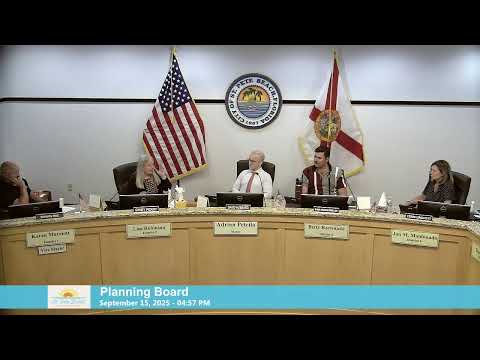
Planning staff told the Planning Board on Monday that the city will commission a research study to establish a valuation range for density-pool bonus units used when developers request allocations that exceed base zoning. Brandon, planning staff, said the study will compare other communities and produce an anchor range "to give the city commission and the planning board something of an anchor to assess benefits against."
The study stems from four existing density pools created in the land development code and from recent cases the board and commission have reviewed, including the Miramar project (approved in January) and the Windward Pass project (denied). Brandon said the pools include base densities (the Miramar site, for example, was eligible for up to 50 units per acre) and limited pools allowing higher densities (up to 70 units per acre in some cases). He said the city never conducted a valuation study when the pools were activated and that proposals to date have shown a varied range of public benefits offered in exchange for density.
Why this matters: commissioners and planning board members have struggled to compare disparate public benefits offered by developers. The staff study is intended to give the city an evidence-based range to inform negotiations and recommendations without creating a codified price. "It's really intended to be a range. We'll never truly nail down an exact value, but it's to give the city commission and the planning board something of an anchor," Brandon said.
Supporting details: staff described the revised scope as a short-term research phase focused on comparable communities; a more robust real estate valuation could follow as a second phase. Staff also said the Tampa Bay Regional Planning Council (TBRPC) will perform economic-impact analysis for individual projects as part of the city's membership benefits, not as a separate paid deliverable. Brandon said staff expects to share a draft with the board at next month's meeting and may later recommend a more detailed market-based valuation if needed.
Board discussion focused on purpose and limits of a valuation. One member observed that the value of additional units ultimately depends on a developer's return-on-investment and on pool scarcity; staff replied the study is not prescriptive and would not be codified.