Get Full Government Meeting Transcripts, Videos, & Alerts Forever!
Get email alerts on the Utility Acquisition Rates Governance topic
No spam. Unsubscribe anytime.
PURA hears arguments on Aquarion sale to regional authority amid rate, governance and enforceability disputes
Summary
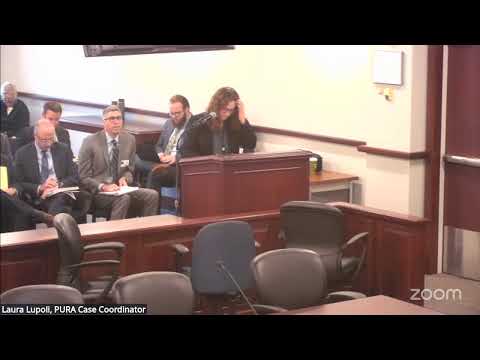
The Connecticut Public Utilities Regulatory Authority on Tuesday heard oral argument on docket 250403, the petition to transfer control of Aquarion Water Company to a new Aquarion Water Authority (AWA) affiliated with the South Central Connecticut Regional Water Authority (RWA).
The Connecticut Public Utilities Regulatory Authority on Tuesday heard oral argument on docket 250403, the petition to transfer control of Aquarion Water Company to a new Aquarion Water Authority (AWA) affiliated with the South Central Connecticut Regional Water Authority (RWA). Petitioners told the authority the transaction would refinance Aquarion’s capitalization and lower long‑term customer costs, while interveners — including four municipalities, the Office of Consumer Counsel and the state attorney general — urged denial, citing governance, rates and the inability to enforce post‑closing commitments.
Attorney Humm, counsel for the joint petitioners, told PURA that the deal is essentially a refinancing and that Aquarion “is as if Aquarion is buying Aquarion,” and that AWA’s nonprofit, debt‑funded model would lower the revenue requirement for future capital spending. Humm said the record projects about $2,000,000,000 in capital investment over the next 10 years and argued that “for every dollar spent on those capital investments, it’s cheaper under AWA ownership,” estimating roughly 25% lower revenue requirement on those projects compared with investor‑owned ownership.
Why it matters: opponents told PURA the change would strip away core consumer protections. David Ball, an attorney representing the towns of Fairfield, New Canaan, Ridgefield and Westport, said the petitioners’ enabling statute removes long‑standing scrutiny — notably the prudency review that the Connecticut Supreme Court described as the primary legal check on monopoly utilities — and that the AWA structure would replace PURA with a largely internal review process. Ball said eliminating PURA oversight and the prudency requirement “is not in the public interest.”
The record and arguments
Petitioners: Counsel for the petitioners and the South Central Connecticut RWA argued the authority model reduces borrowing costs, eliminates an equity return and corporate taxes, and retains Aquarion’s operating staff. Daniel Canavan, counsel for the RWA, described the transaction as “very unique” in Connecticut and said the water authority model lets revenues remain inside the system for reinvestment rather than pay investor returns.
Petitioners also said the authority’s representative policy board (RPB) will be the economic regulator for AWA and that budgets, ten‑year plans and bond issuances will be vetted publicly throughout the year. Counsel said credit rating assumptions supporting the financing depend on the enabling statute and the RPB transition process.
Opponents: Municipal attorneys, MetroCOG, the Office of Consumer Counsel (OCC) and the attorney general raised several central objections: (1) loss of independent regulatory oversight and the statutory prudency standard; (2) board composition and conflicts of interest because RWA appointees would hold a permanent voting majority on AWA’s operating board under the current legislative design; (3) whether projected savings are supported by the record; and (4) enforceability of post‑closing commitments.
Allison McCormick of the Office of Consumer Counsel told PURA the OCC remained unconvinced the record shows the AWA model is financially superior and urged that “any commitments made by the applicants must include some sort of enforceability mechanism.” Attorney McLeod for MetroCOG and other municipal counsel said towns uniformly oppose the application and criticized the proposal’s effect on property tax treatment and pilot payments that would replace current property tax revenue.
Unresolved issues and what parties proposed next
No formal action was taken at the hearing. Multiple parties told PURA they are discussing post‑filing commitments and said they may submit additional proposals under the statute that allows settlement discussions and submitted resolutions. Petitioners told the authority they are working on enhanced commitments and a special transition committee to address governance and conflict‑of‑interest issues, and asked PURA to consider those proposals if filed before a final decision. Interveners said they have not been included in those discussions and urged that, if anything is to change, it should be documented, enforceable and part of the record before approval.
What PURA must decide
Under the statutes cited during argument, PURA must find that a change of control is in the public interest and may evaluate managerial, technical and financial fitness. Parties disputed how much weight the authority should give to the enabling statute’s design versus PURA’s independent assessment of public‑interest criteria; interveners said the legislature’s delegation to PURA to review the application means PURA must evaluate governance and consent by affected municipalities as part of the public‑interest test.
Next steps
PURA took the matter under advisement. Parties indicated they may file additional commitments or settlement proposals before the authority issues a draft decision. PURA said it will issue a decision on the docket after considering the full record, briefs and Tuesday’s oral arguments.