Get Full Government Meeting Transcripts, Videos, & Alerts Forever!
Get email alerts on the Student Technology Policy topic
No spam. Unsubscribe anytime.
Parkrose superintendent outlines student personal-device policy, plans Oct. 31 adoption
Summary
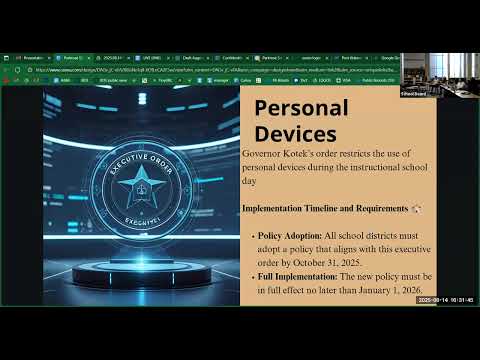
Superintendent presented a drafted personal-device policy that would bar phones during instructional time, set administrative rules for accommodations and storage, and require the board to adopt a final policy by Oct. 31; high-school possession rules and emergency/translation protocols were discussed but no vote was taken.
Superintendent presented a draft personal-device policy and told the Parkrose School District Board that the administration plans to bring a final policy for adoption by Oct. 31. The draft would bar students from using phones during instructional time and set administrative rules for how exceptions and accommodations are handled.
The superintendent said, “we have to adopt the policy by October 31,” and described the draft as aimed to keep phones “not out during instructional time.” She explained the proposal treats elementary and middle school students more restrictively and gives high-school students greater possession but requires phones to be put away during instruction.
Why it matters: the board will consider a districtwide rule that affects every student’s daily classroom routine and touches on special-education accommodations, parent communications and campus safety procedures.
Discussion points included: how the district will handle students who need phones for documented medical or assistive-technology reasons (the superintendent said those would be covered by an IEP or similar plan), the administrative rule the district will create to require documentation from parents for exceptions, and classroom-level storage approaches. The superintendent described an intended sequence: teachers coach students during the initial month of implementation, classroom storage options will be provided, and repeated misuse would lead to office referrals.
The board and staff discussed how the policy would work during passing time, lunch, theater, library and other non-instructional spaces; the superintendent said the policy’s core is “during instructional time” and clarified that commons or free periods at high school would be treated differently than instructional spaces. She also described a staged rollout: teacher training, student coaching and pilot messaging for families in multiple languages.
On emergency communication and translations, the superintendent said the district’s mass-notification system supports “50 languages” and that administrators will work with culturally specific partners to make sure families receive critical information in an emergency.
The policy draft does not include a final disciplinary matrix in the public discussion. No formal motion or vote to adopt the policy occurred at the meeting; the superintendent said she will return with a refined draft and administrative rules ahead of the October deadline.
Ending: Board members asked clarifying questions about field trips, restroom use during class and volunteers’ expectations; the superintendent said those operational details will be covered in the administrative rule and in staff training before the policy’s next review.