Get Full Government Meeting Transcripts, Videos, & Alerts Forever!
Get email alerts on the Public Safety Fire topic
No spam. Unsubscribe anytime.
Contra Costa Fire outlines post‑annexation operations, new air and water resources
Summary
Contra Costa County Fire Protection District told the Pinole City Council it has completed operations integration after the Rodeo‑Hercules annexation, has new helicopter and helopod water‑delivery capacity, and plans a replacement Type‑6 engine for Pinole; officials emphasized home hardening and defensible‑space rules as wildfire risk rises.
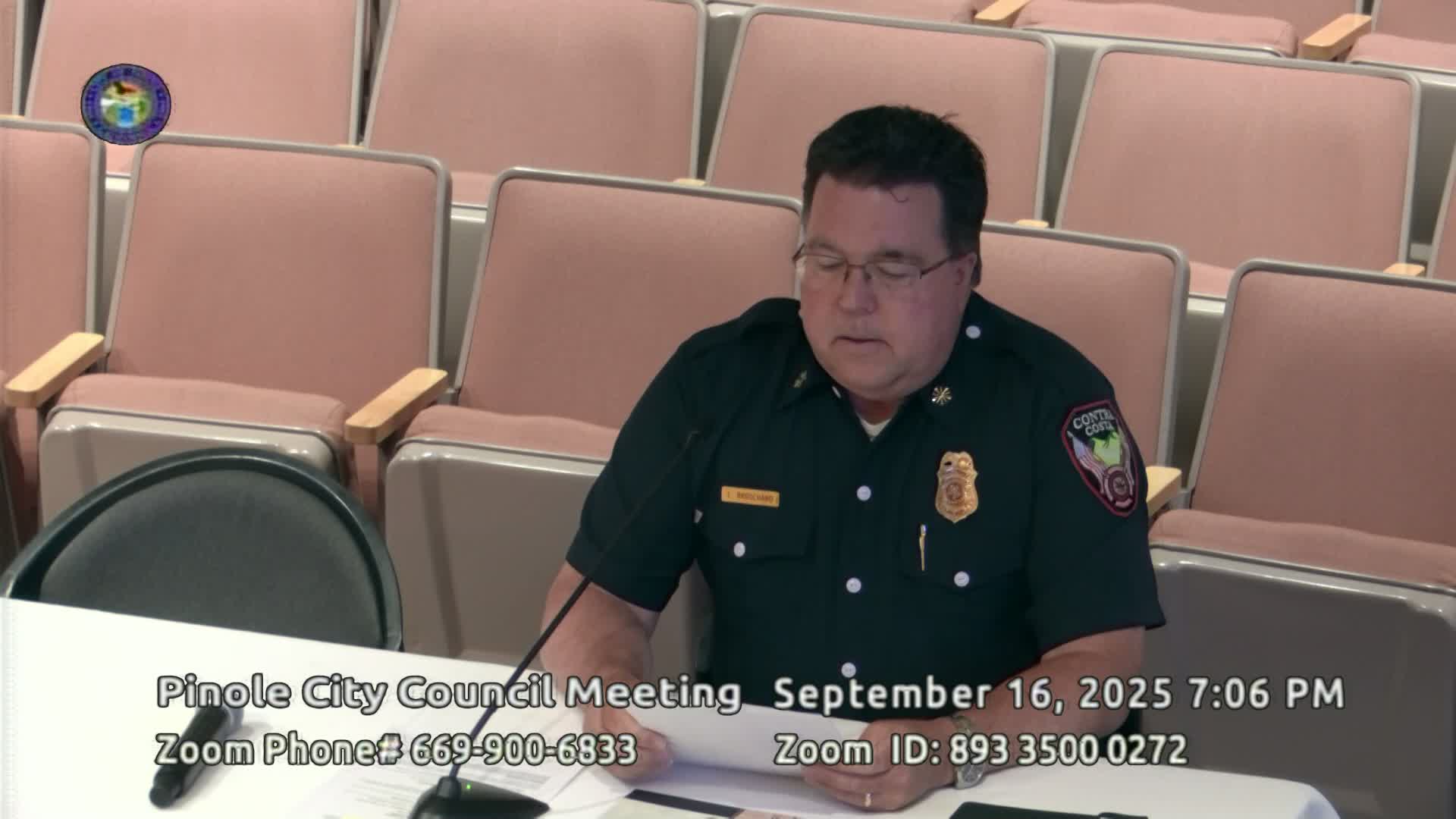
Contra Costa County Fire Protection District Chief Weingkoop told the Pinole City Council on Sept. 16 that the district completed the July 1 annexation of the Rodeo‑Hercules Fire Protection District and is now operating 37 stations and 41 companies across West County.
Why it matters: The annexation consolidated battalion resources and, the chief said, created “increased efficiency, firefighter safety and fiscal sustainability” for emergency response across the district’s 582 square miles. Council members pressed the district on longer‑term wildfire prevention measures and on what cities can do to support home hardening.
The chief said the district is deploying new aviation and water‑delivery tools this fire season. Copter 1, a contracted helicopter, has flown since the start of the season with a 300‑gallon tank and a snorkel system for rapid refills; helopods—engineered tanks of roughly 3,700–4,000 gallons—have been placed in locations without reliable water sources to shorten refill time. The district reported more than 55,000 gallons dropped by Copter 1 during its early months in service. The helicopter contract runs through October and carries an approximate $2 million price tag, about half of which the district said was covered by PG&E.
Chief Weingkoop also said the district ordered a new Type‑6 wildland engine to replace an apparatus more than 20 years old that previously served Pinole; the new apparatus was reported to be at the dealer in Sacramento and expected for delivery in the coming weeks. He said the Type‑6 engines improve access to vegetation and exterior fires and help contain incidents before they grow.
On prevention, the chief urged homeowners to prepare for ember‑driven fires and renewed the district’s support for stricter defensible‑space and home‑hardening standards. He described recent wildfire inspections and field visits—citing examples where new construction built to Chapter 7A standards survived a wind‑driven fire while older nearby structures did not—and said state regulatory changes under consideration could require “zone 0” defensible‑space measures and other home‑hardening steps. “Your home has to stand on its own,” the chief said, adding that the discipline is necessary because there are “way too many homes and not enough engine companies” to protect every structure.
Council members asked how the city can help. The chief recommended an education campaign, consistent local implementation of any new state rules, and partnering on grant or low‑income assistance programs so households can complete hardening work. He said enforcement authority is limited outside designated high‑hazard zones until the state finalizes new regulations.
The presentation also included district operational data for Pinole: call volumes have been generally stable month‑to‑month, with medical calls and ambulance responses comprising a large share; two residential care facilities showed multiple repeat medical calls. The chief encouraged residents to sign up for county emergency alerts and promoted Con Fire outreach events, including an October open house at the district training campus.
What’s next: The district said it will continue to brief cities as new state regulations on home hardening and defensible space are developed, and it will return with operational updates and community outreach plans. The council did not take formal action at the Sept. 16 meeting.