Get Full Government Meeting Transcripts, Videos, & Alerts Forever!
Get email alerts on the Water Resource Management Strategic Plan topic
No spam. Unsubscribe anytime.
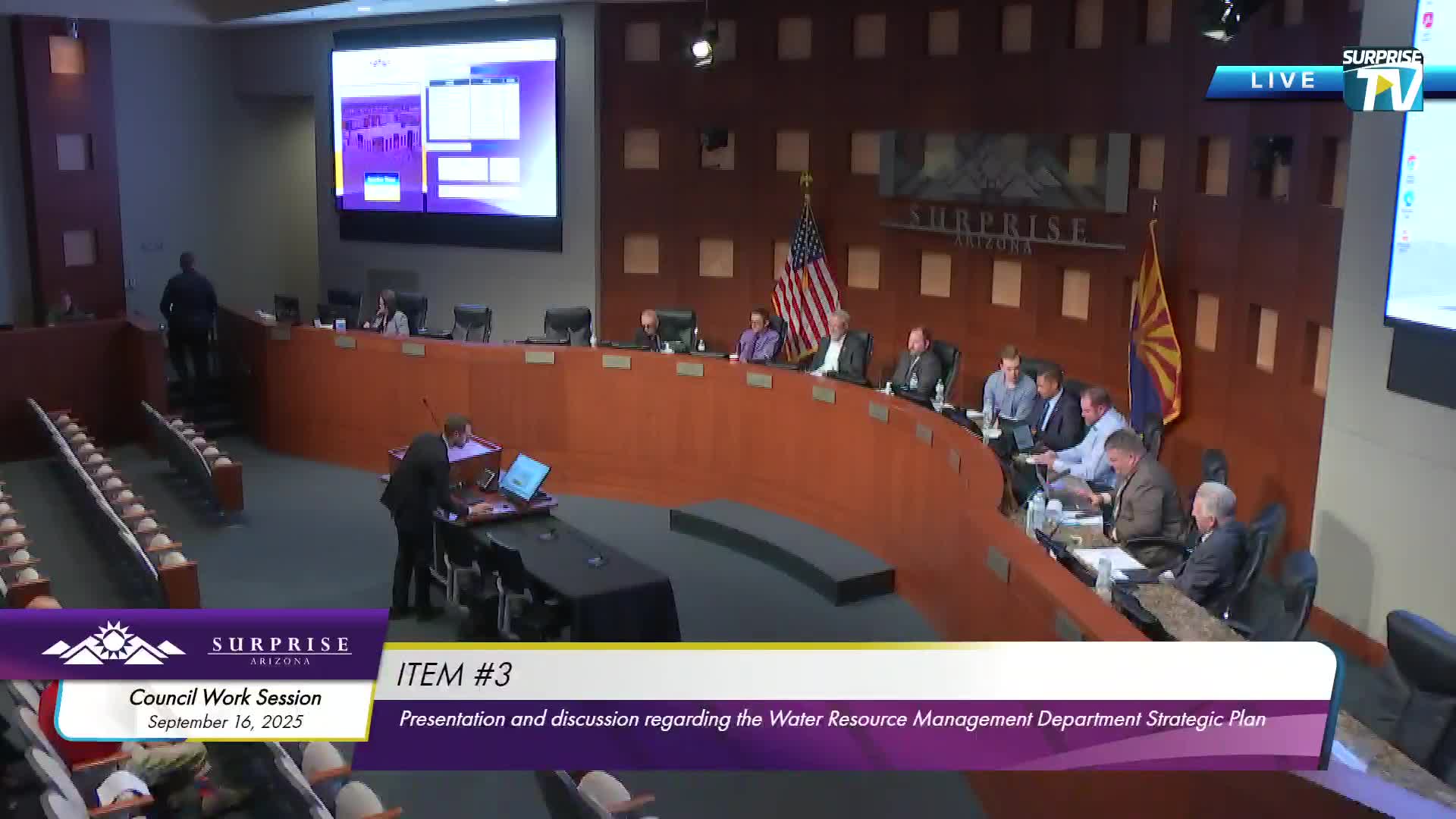
Water department outlines strategic plan to secure supply, expand conservation and pursue interconnects
Summary
Water Resource Management staff presented priorities tied to the council’s strategic plan: maintain assured water supply, promote conservation, update the water resource master plan, deploy Hydrant AI leak detection and pursue interconnects with EPCOR for redundancy; staff noted Colorado River rule changes in 2026 as a key uncertainty.
Mike, a Water Resource Management Department presenter, told the council the department serves roughly 90,000 residents with water and manages 22 well sites, seven water supply facilities, four wastewater plants and thousands of sewer miles, and laid out goals to support council strategies on supply resilience, conservation and responsible growth.
Why it matters: staff said Surprise must maintain its designation of assured water supply, keep two times renewable supply compared with annual demand and hold 15 times the annual demand in long‑term storage or paper water per existing city policy. The department’s stated FY26 priorities include completing a water resource master plan (2026), connecting 10 supply facilities to city fiber for cybersecurity and reliability, deploying 60 Hydrant AI modules to detect leaks and low pressure, and pursuing two interconnects with EPCOR to add redundancy across pressure zones.
Details and challenges: Mike said current annual demand is about 10,000 acre‑feet and that city policy therefore targets a portfolio with about 20,000 acre‑feet of renewable resources; the department will return to the state on assured‑supply updates in 2032. Staff flagged the end of the current Colorado River operating guidelines in 2026 and possible municipal reductions as a key uncertainty and noted rate‑study assumptions, evolving water quality rules and operator recruitment as operational challenges.
Opportunities: staff described regional partnerships, technology options including advanced water purification and desalination concepts, and active grant pursuit. Council members praised the department’s conservation outreach and asked technical questions about Hydrant AI units; staff said the units are small, battery‑powered devices mounted to hydrants that monitor noise/pressure signatures and have already detected leaks.
No policy votes: the presentation was for information; council praised the department’s work and did not take formal action.