
Commission approves first reading of new water and wastewater rates after staff, consultant outline 7.9% revenue plan
Get AI-powered insights, summaries, and transcripts
Subscribe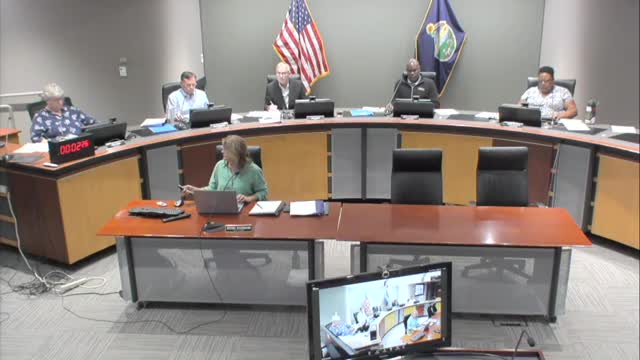
Summary
On first reading commissioners approved Ordinance No. 10163 to update water and wastewater rates; staff and consultant said the revenue package equates to a roughly 7.9% aggregate revenue increase over the adopted term, citing asset work and debt-service targets.
On Sept. 16 the Lawrence City Commission gave first-reading approval to Ordinance No. 10163, which updates the city's water- and wastewater-rate schedules. The motion passed on a 5-0 voice vote; staff said second reading is scheduled for Oct. 7 and rate changes would take effect Jan. 1, 2026 if the ordinance is adopted.
City staff and the city's rate consultant presented a multi-year financial forecast tied to the city's capital-improvement plan for water and wastewater infrastructure. Colin Dratt of Raftelis told the commission the proposed revenue plan would generate roughly a 7.9% aggregate increase across utility revenues over the adopted period. The consulting team said the forecast balances projected operating costs, inflation and capital financing needs while aiming to meet the city's reserve policies and a debt-service coverage ratio target of roughly 1.7.
The presentation noted recent capital and system work including a distribution-system master plan, replacement of Stratford Water Tower, replacement of a 24-inch transmission main on New York Street and completion of the city's advanced meter infrastructure program. Staff also reviewed ongoing projects at the wastewater plants, including upgrades at the Kansas River Wastewater Treatment Plant to meet nutrient limits and the Kaw Water Treatment carbon contact basin replacement project. Staff noted the Municipal Services & Operations campus (Phase 1) project budget at roughly $64.8 million, of which $23.6 million was identified as supported by the water/wastewater fund in the current budget documents.
Consultant Dratt and city staff also explained how the rate structure balances fixed monthly charges and volumetric charges across customer classes and provided an example: a typical 4,000-gallon household bill would rise by roughly $8–$10 per month in the first year under the proposed structure, staff said, with variations by customer class. Staff and the consultant emphasized the plan is intended to keep rates relatively stable year to year and to preserve bond covenants and the city's credit metrics.
Public commenters raised the scale of recent and proposed rate increases. The Coalition for Collaborative Governance presented comparative charts showing substantial increases in water, wastewater and other utility fees over recent years and projected additional increases. Coalition representative Holly Krebs said the group's chart showed a 54% increase in water and wastewater rates over the last five years and a projected 25% rise over the next three years; she urged the commission to consider the cumulative impact on households and to publish clearer long-term debt-payment plans. Several commenters also asked for clearer accounting of how MSO campus costs and other capital projects are reflected in utility-rate planning.
After discussion, Commissioner Finkelstein moved first-reading adoption of Ordinance 10163 and Commissioner Sellers seconded. The motion passed 5-0. Staff will return for a second reading of the ordinance on Oct. 7.
Clarifying details from the presentation: staff said the water/wastewater fund is supporting about $23.6 million of the MSO campus Phase 1 total budget of roughly $64.8 million; staff and consultant cited reserve targets of approximately 250 days of operating expenses and a debt-service coverage goal near 1.7; the consultant described proposed revenue adjustments targeted at about 7.9% across water and sewer combined over the period presented.
Speakers quoted or cited in this article are listed below.