
King County council holds wide-ranging discussion on DCHS contracting after auditor report; no vote taken
Get AI-powered insights, summaries, and transcripts
Subscribe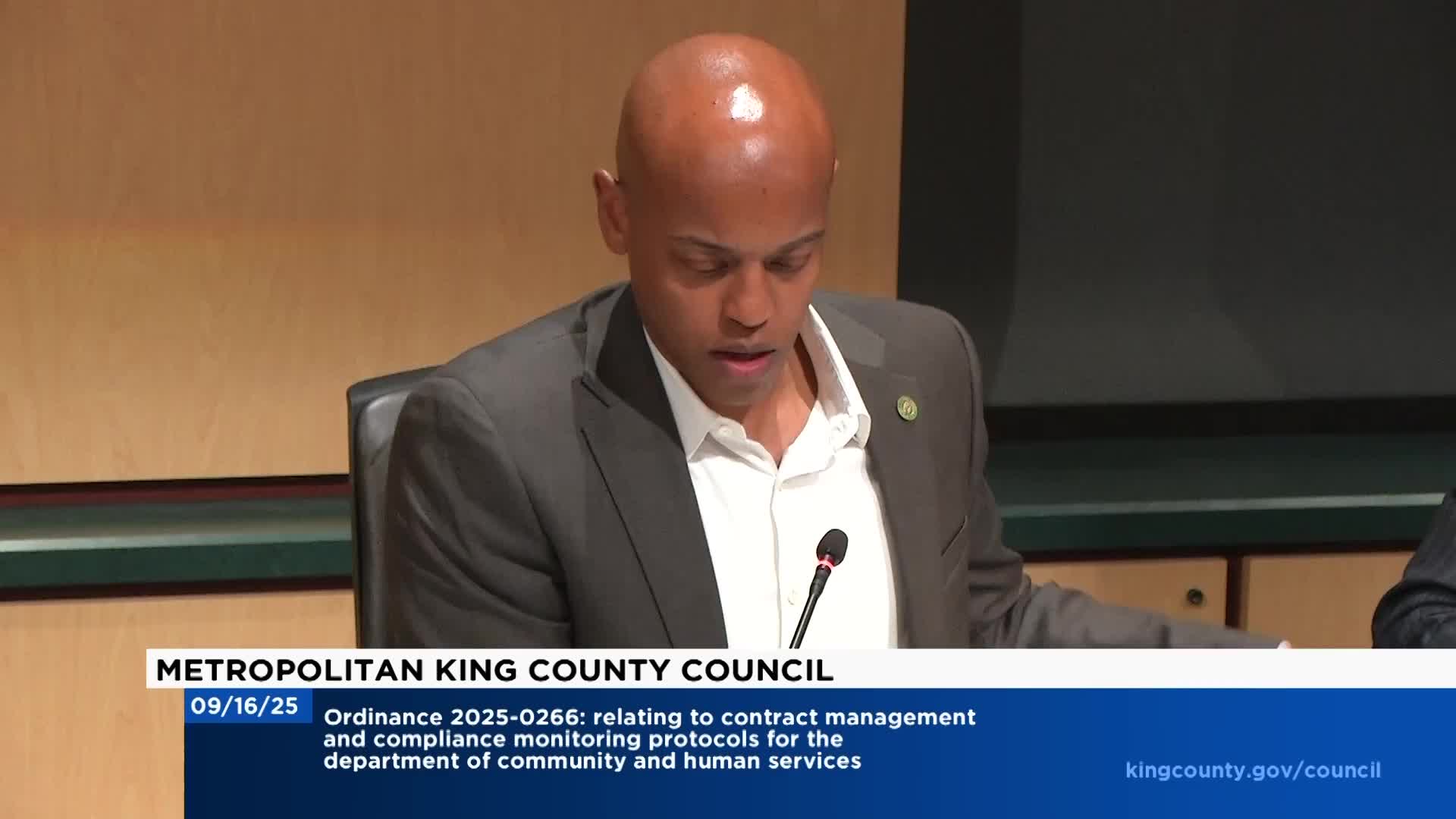
Summary
Councilmembers and department leaders discussed an ordinance to codify contract-management best practices for the Department of Community and Human Services after a county audit flagged weaknesses; the council held the item for a week of amendments and asked the department for follow-up briefings and reforms.
The Metropolitan King County Council on Sept. 16 held a detailed, hour-long discussion of a proposed ordinance that would require the Department of Community and Human Services to adopt and follow strengthened contract-management and compliance-monitoring practices after a recent audit flagged problems.
The proposed ordinance (Ordinance 2025-0266) would require DCHS to document and implement best practices for contract management, perform annual risk assessments of contract agencies and conduct in-person site visits of each contract agency at least once every three years. It also calls for a status briefing to the council by March 31, 2026, on implementation of audit recommendations.
Why it matters: Council members described the audit findings as eroding public trust and said the county must act to ensure taxpayer funds are managed properly while protecting service delivery for vulnerable residents. The department and council members also discussed staffing, training and possible structural changes to reduce future risk.
Councilmember Reagan Dunn, who introduced the ordinance, said the audit shows the county is “going to have to clean up our side of the street first” and invited colleagues to propose amendments to strengthen the bill. Dunn noted the audit examined a portion of grant spending and called for reforms to make contracting more manageable and accountable.
DCHS Director Kelly Ryder acknowledged deficiencies in the department’s past administrative capacity and told the council the department is pursuing multiple steps to respond. Ryder said the department has implemented a new contract compliance monitoring policy, begun anti‑fraud training for staff, engaged an external consultant to strengthen internal controls and is preparing budget requests for additional fiscal and compliance staff. “We have not had sufficient financial and compliance staff to keep up,” Ryder said.
Department numbers and audit scope: Ryder told the council DCHS contracts with roughly 580 providers and is investigating about 19 payment items the auditor flagged. She said the department is looking into “less than $1,000,000” of questioned payments out of a roughly $1.5 billion DCHS budget; those figures were stated to the council by the department during the meeting. The auditor’s published report contains 10 recommendations; the county executive and DCHS concurred with those recommendations, according to council staff materials.
Several council members urged a two‑track response: (1) immediate operational changes, training and increased staffing inside DCHS; and (2) structural accountability such as more frequent independent audits or outside oversight. Councilmember Dave Dombowski suggested exploring outside reporting incentives and strengthening the county auditor’s role; Councilmember Kathy Perry urged investments in systems and a single data platform to reduce administrative burdens for providers.
Community providers and nonprofits who testified urged the council to balance accountability with technical help. Nela Kamein, executive director of Encompass, told the council that “community‑based organizations who hold government contracts already spend a significant amount of staff time and money to manage those contracts,” and asked that any new requirements come with financial and technical support. David De La Fuente, executive director of Communities and Schools of South King County, and Karen Sharp, COO of King County Sexual Assault Resource Center, made similar requests to avoid imposing requirements that would imperil fragile provider operations.
Next steps: Chair Germaine Zahilay said the council intends to take action on the ordinance at its meeting on Sept. 23. Council staff asked members to submit amendment concepts by close of business Friday. Director Ryder and DCHS pledged follow‑up briefings and continued implementation work; the ordinance itself requires a status briefing to the council by March 31, 2026.
The council’s discussion was procedural and deliberative; no ordinance vote was taken Sept. 16. Members repeatedly emphasized the dual objectives of restoring public trust by strengthening oversight while preserving service continuity for clients who rely on community‑based providers.
Taper: The council requested specific amendment proposals and reiterated a need for more staffing, technical assistance to smaller providers and better IT systems within DCHS to reduce paperwork and improve timely payments, tasks the department says it is already pursuing.