
Board recommends county fund up to $935,000 for Forks mill repairs and PUD upgrades, contingent on lease
Get AI-powered insights, summaries, and transcripts
Subscribe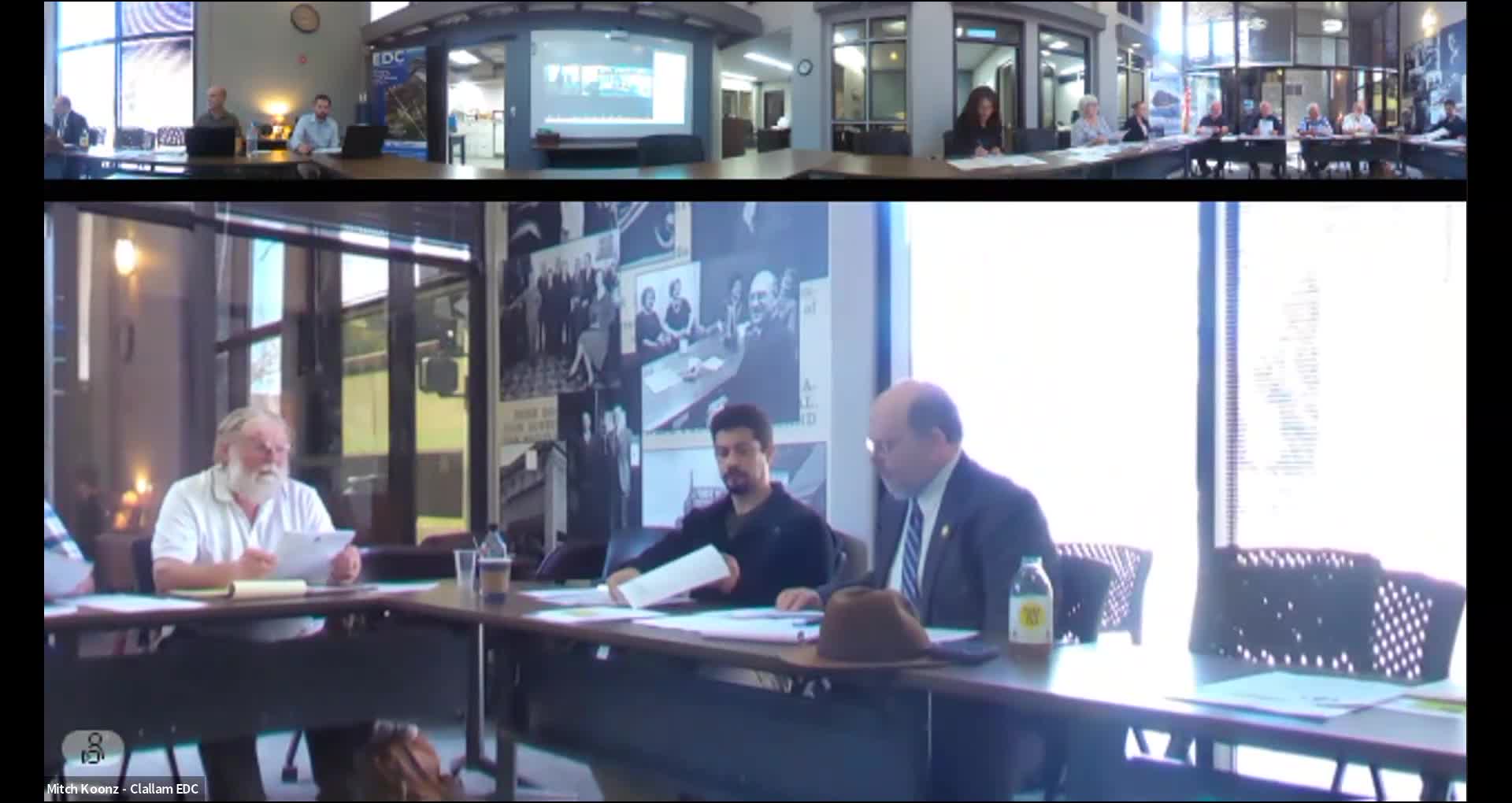
Summary
The Clallam County Opportunity Fund Board voted to recommend that the Board of County Commissioners approve a $260,000 loan and a $675,000 grant to support building repairs and electric service upgrades at the Forks Industrial Park for a proposed Riverside Forest Products USA sawmill, contingent on execution of a lease.
The Clallam County Opportunity Fund Board voted to recommend that the Clallam County Board of Commissioners provide a $260,000 loan and a $675,000 grant — a combined $935,000 — to support repairs and utility infrastructure upgrades at the Forks Industrial Park for a proposed Riverside Forest Products USA sawmill, contingent on the City of Forks executing a lease with Riverside. The recommendation was moved, seconded and approved by the Opportunity Fund Board with one member abstaining; the recommendation now goes to the county commissioners for a final decision. The board’s program administrator, Colleen (Program Administrator), framed the legal scope for use of the Opportunity Fund, citing state and county provisions. “RCWs 82.14.370 and 43.33.010 and County code 5.4.041 cover the Opportunity Fund program and the use of proceeds,” Colleen said, noting the fund can be used for countywide economic development, public infrastructure for economic development, and, more recently, affordable workforce-housing infrastructure. Rob Buckman, City of Forks planning planner, described the applicant’s proposal and the site. He said Riverside Forest Products USA would operate a sawmill and related on-site operations at the Forks Industrial Park and that the company expects to create roughly 40 to 50 jobs initially. “Riverside is proposing that once they have their milling operation going, they would have 40 to 50 employees,” Buckman said, adding he had used a conservative estimate of 40 jobs for the application. Buckman outlined two parts to the city’s request to the Opportunity Fund: a loan to support building repairs and tenant improvements on the 84,000-square-foot former mill building (including insulation and office repainting), and a grant to pay for electrical infrastructure upgrades needed to serve the mill from the local Public Utility District. He said the city’s estimates included about $125,000 for repairs and a $625,000–$675,000 estimate for PUD upgrades and trenching, with a note that trenching costs might be lower than estimated because the distance from the substation is roughly 2,200 feet. The loan terms the board recommended are a 20-year amortization with a five-year deferral, and interest tied to the Local Government Investment Pool (LGIP) rate at the time of award, not to exceed 4.5 percent. Board members discussed tying the rate to LGIP so the county treasurer could match actual investment returns at award time. Board members raised supply and market risks in questions for Riverside. Joe Murray, an Opportunity Fund board member, said he supported the request but voiced concerns about timber supply volatility and market shifts. “I’m simply concerned about the supply,” Murray said, but added he favored the application because it would bring local manufacturing jobs. Representatives for Riverside and city staff told the board the company has preliminary timber-supply discussions and expects to work with local private landowners and state timber sources; Riverside’s representatives described the operation as sized to run on roughly 36 million board feet a year and said they had begun some site work under a license agreement while lease terms were negotiated. Riverside figures presented by city staff estimated average wages in the $28–$31.80 per hour range; Buckman said his analysis used the more conservative $28 per hour figure. The board’s program administrator also reported on fund balances: the Opportunity Fund receives a small remittance of state sales tax for rural counties (0.09 percent of the state’s share), which yields roughly $1.45 million in a typical year; staff noted an existing pattern of setting aside reserves and debt-service coverage when recommending awards. Colleen said the county CFO had already confirmed sufficient funds existed to consider this application. Discussion included alternatives for the PUD work (open trenching vs. bored conduit) and archaeology and permitting steps cited by staff as likely requirements before trenching. Board members and city staff said planned bid specifications would include alternatives and contingencies for permitting and cost overruns. The board’s formal recommendation, as read into the record, was to recommend that the county commissioners fund a loan of $260,000 amortized over 20 years with a five-year deferral and an interest rate tied to the LGIP at time of award (not to exceed 4.5 percent), and to award a grant of $675,000; both awards were stated to be contingent upon the City of Forks successfully executing a lease with Riverside Forest Products USA. The board closed the public hearing and voted on the motion; the motion passed with one abstention. The recommendation and all application materials will be forwarded to the Clallam County Board of Commissioners for their decision. If approved by the commissioners, city staff and Riverside would proceed with the lease and then bid the PUD and repair work subject to the conditions and contingencies discussed.