
Champaign council approves $62,130 Main Street viaduct fence amid dispute over homeless encampment
Get AI-powered insights, summaries, and transcripts
Subscribe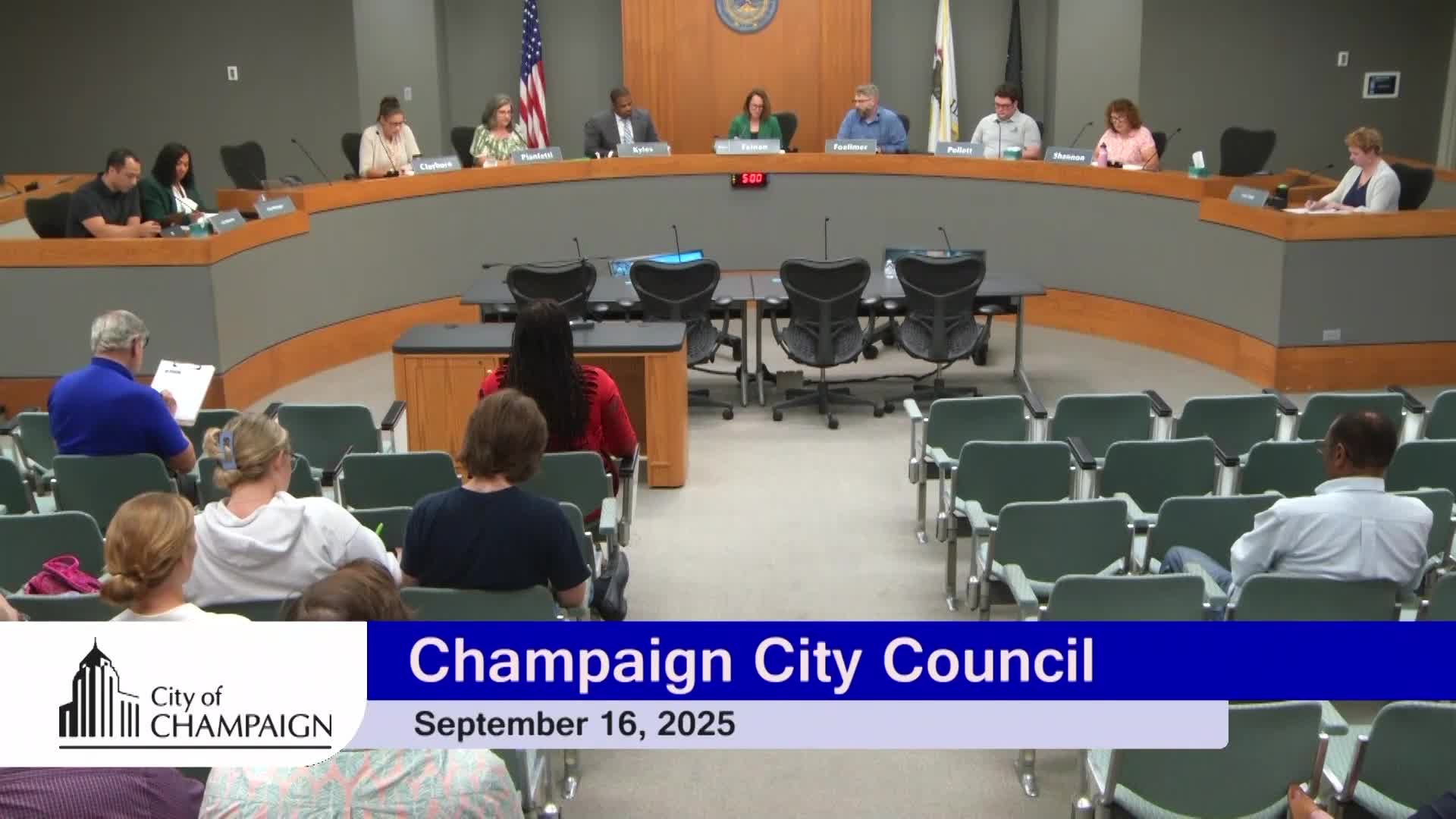
Summary
The council approved a $62,130 contract to install fencing at the Main Street viaduct, voting 6-1 after heated public comment and debate about whether fencing displaces unhoused people or protects public safety and businesses downtown.
The Champaign City Council on Sept. 16 approved a $62,130 contract to install a fence at the Main Street viaduct, voting 6-1 to accept the low responsive proposal from Century Fence Company of Pewaukee, Wisconsin.
The measure, Council Bill 2025-163, passed after public commenters and council members debated whether the fence — and a plan for gates — is a temporary measure to manage safety and sheltering under the viaduct or an avoidance of wider homelessness solutions.
The council’s action authorizes the city manager to execute the agreement for installation of fencing at the Main Street viaduct. City staff said the Wisconsin bidder was the lowest responsible proposer and that local preference points did not bridge the price gap to a local vendor.
Public commenter Mark Medlin told the council the fence was “avoiding the problem” and said enforcement and arrests should be used instead of fencing. He warned the fence would discourage downtown visitors and compared it to “the Berlin Wall.”
Another commenter, Alan Nudo, said the closure has improved conditions for nearby businesses and urged the council to control gate hours. He suggested gates remain closed until measurable improvements occur and that gates be opened at sunrise and closed before sundown to avoid exposing people to the elements overnight.
Council debate reflected tension between those who said the viaduct had become unsafe for bicyclists and downtown users and those who said the measure displaces vulnerable people. Deputy Mayor Kyles and Councilmember Shannon said they supported the temporary fencing while pursuing broader, dignified homelessness solutions. Councilmember Fulmer said he would not support the measure and emphasized the human impact of displacing people who are unhoused.
City Attorney remarks in the meeting noted limits on arresting people for mere presence in right-of-way; police enforcement requires an obstruction or public-safety hazard, and recent Illinois case law narrowed loitering ordinances. Councilmembers repeatedly framed the fence as a temporary, adaptable tool and said the city needs countywide partners to address homelessness.
Councilmember Paul cast the lone recorded “no” vote; the motion carried 6-1. Councilmembers who voted in favor did not attach an immediate schedule for gate operation but discussed returning with additional policy and operational guidance. Councilmembers also referenced ongoing work with service providers including Strides and noted Strides’ funding horizon as a factor in planning.
The council did not adopt new enforcement ordinances at the meeting. Next steps identified in discussion included operational decisions about gate hours and continued coordination with county and nonprofit partners on sheltering and services.