
Baltimore reports preliminary FY25 general fund close: small net deficit after timing issue with school payment
Get AI-powered insights, summaries, and transcripts
Subscribe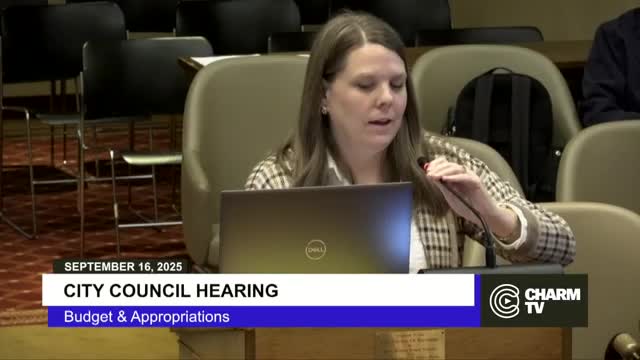
Summary
City budget officials presented preliminary, unaudited FY25 general fund results showing a $3.3 million net deficit driven by higher-than-expected expenditures and a one-time timing payment for city schools; officials said supplementals will cover deficit items from FY25 surpluses and agency savings.
Baltimore City budget officials told the City Council’s Budget and Appropriations Committee on the quarterly briefing that preliminary, unaudited FY25 results show the general fund closed with a $3,300,000 deficit after year‑end revenues exceeded budget by about $66,600,000 and expenditures exceeded budget by about $69,900,000. "I am here to present the preliminary and unaudited results for the city's general fund for the fiscal year that ended on June 2025," said Laura Larson, the city's budget director.
The deficit is concentrated in a handful of large expenditure items and a timing issue for a prior‑year payment to Baltimore City Public Schools, Larson said. "If we exclude the issue regarding the timing of the payment for city schools, the city's general fund actually ended the year with a $13,300,000 surplus," Larson said, adding that the prior‑year schools payment will be funded from the FY24 fund balance that lapsed to fund balance.
Why it matters: the briefing lays out which revenues and spending items produced the variances that will drive supplemental appropriations this fall. Larson said income tax receipts and stronger property and transfer/recordation taxes helped revenues, but large contract and overtime costs—especially for police and fire—pushed expenditures above budget.
On the revenue side, Baltimore received unexpectedly large “unallocated withholdings” from the State of Maryland in the fourth quarter. Larson said the city received $27,400,000 in unallocated withholdings against a budget assumption of $10,600,000 and a five‑year average near $16,000,000. Income tax final collections were roughly $42,000,000 above the budgeted amount (about a 9% variance from a $466,500,000 budget to a $508,900,000 preliminary actual), Larson reported. She noted that income tax is collected and allocated by the state and that the city must rely on state data and formulas.
Property tax and transfer/recordation taxes also outperformed budget. Larson said real property tax collections improved (final collection rate shown at 98.5% versus a projection of 97.5%) and the city’s property tax preliminary actual was roughly $7,500,000 above assumptions. Transfer and recordation taxes came in about $12,700,000 over budget, helped by a higher number of transactions and rising average residential sale prices.
On the expenditure side, Larson identified several drivers of the FY25 overspend: a $12,000,000 city contribution for the City Springs redevelopment (an elementary and middle school tied to the PSO project) that was not included in the FY25 budget; finalized union contracts for police and fire that exceeded budget assumptions by roughly $20,000,000; and overtime and contractual EMS costs in the fire department. The briefing showed the fire department’s deficit at about $38,500,000 (15% variance) and the police department’s deficit at about $47,500,000, largely driven by the FOP contract and overtime, Larson said.
Larson also described vacancy trends and overtime. The city ended FY25 with just over 1,500 general fund vacancies, a 15% overall vacancy rate, and reported vacancies concentrated in police officer positions (462 vacancies at fiscal year end) and in positions such as office support specialists, paramedics, deputy sheriffs, community health nurses and CDL drivers. Total overtime spending across agencies was reported at about $140,600,000 for FY25; police and fire accounted for most overtime spending.
Discussion and next steps: Larson said that, under the charter, the Bureau of Budget and Management Research (BBMR) will initiate supplemental appropriations to address FY25 agency deficits. She said the source for supplementals will include FY25 surplus revenues and agency surpluses, and that the prior‑year schools payment will be paid from the FY24 fund balance that lapsed to fund balance. "Per the charter, BBMR will be initiating supplemental appropriations for all of the agencies that ended the year in deficit," Larson said.
Council members asked about controls put in place after third quarter and about longer‑term risks. Larson said spending controls—such as additional review of discretionary overtime, tighter purchasing‑card controls and extra review of contractual spending—were imposed in the third quarter and helped reduce projected deficits for some agencies. She cautioned that income tax revenue remains volatile because it is a lagging indicator of labor market changes and tied to state allocations; she recommended continued caution given federal and state employment trends.
The committee did not take a vote during the briefing. BBMR staff said formal supplemental appropriations and specific appropriation language will be brought forward for council action in October and November.