Council approves expanded Energy Project Reserve Fund budget to fuel EV chargers, pickups and equipment
September 16, 2025 | South Burlington City, Chittenden County, Vermont
This article was created by AI summarizing key points discussed. AI makes mistakes, so for full details and context, please refer to the video of the full meeting. Please report any errors so we can fix them. Report an error »
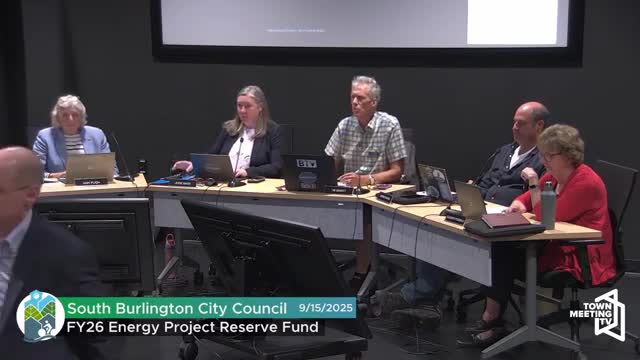
The South Burlington City Council on Sept. 15 voted unanimously to approve a revised FY26 budget for the Energy Project Reserve Fund (EPRF), a revolving fund the city uses to finance energy-saving capital projects. Climate Action Manager Bettina (last name not specified in transcript) and Energy Project Manager Lou (last name not specified in transcript) presented the plan and the council approved it after discussion.
"The Energy Project Reserve Fund was created by city council resolution in 2019 to make capital improvements to city facilities, reduce the use of energy," Bettina said, explaining the fund's revenues come from solar arrays and savings generated by efficiency projects. She reported an unaudited reserve balance of $476,866 at the end of the last fiscal year and asked the council to approve increasing FY26 allocations from $65,000 to $187,500 to address several near-term needs.
Key allocations in the approved FY26 EPRF budget include: funds to pursue installation of faster public chargers at the police station (the city seeks to capture a 30% federal tax credit if the deadline and eligibility align); approximately $23,000 to support purchase of an electric pickup for the fire marshal (the city is monitoring federal tax-credit timing and delivery deadlines); roughly $30,000 as a pool to support electric mowers or an electric pickup in the highway/public works fleet (the department has not yet selected specific equipment); $45,000 to install an EV charger at the wastewater (Airport Parkway) site and to pilot a paint project on a digestion tank to capture additional radiant heat; and $25,000 for small electric equipment and consulting studies (the council's package includes $7,500 already approved earlier).
Energy staff said some planned work in the FY26 CIP (capital improvement program) was reallocated: the previously budgeted Fire Station 1 EV chargers and a Public Works window project were reprioritized after staff concluded the station chargers were addressed and the window replacement would not yield major energy savings. Bettina said the police-station chargers being proposed are similar in user flow to the City Hall chargers but will be higher-capacity units and will qualify for federal incentives if timing and eligibility align.
Lou described a low-cost pilot at the wastewater treatment site generated by an engineering student's tests: black-painted squares on the digester tank have shown temperature differences as much as 20'25 degrees Fahrenheit on hot days, which can reduce natural gas heating demand. The council approved $45,000 in the EPRF to support an EV charger at the Airport Parkway site and to pursue the painting and repair work on the digester tank, subject to procurement and quotes.
Councilors asked staff to return future budget updates showing the net cost after expected rebates, credits and incentives (for example, EV vehicle incentives or charger credits), and staff agreed to present a revenue/net-cost view in future EPRF reports.
The EPRF budget passed unanimously. Staff said the new approach'presenting an annual budget for the EPRF'is intended to improve transparency about both allocations and the fund's ongoing balance.
"The Energy Project Reserve Fund was created by city council resolution in 2019 to make capital improvements to city facilities, reduce the use of energy," Bettina said, explaining the fund's revenues come from solar arrays and savings generated by efficiency projects. She reported an unaudited reserve balance of $476,866 at the end of the last fiscal year and asked the council to approve increasing FY26 allocations from $65,000 to $187,500 to address several near-term needs.
Key allocations in the approved FY26 EPRF budget include: funds to pursue installation of faster public chargers at the police station (the city seeks to capture a 30% federal tax credit if the deadline and eligibility align); approximately $23,000 to support purchase of an electric pickup for the fire marshal (the city is monitoring federal tax-credit timing and delivery deadlines); roughly $30,000 as a pool to support electric mowers or an electric pickup in the highway/public works fleet (the department has not yet selected specific equipment); $45,000 to install an EV charger at the wastewater (Airport Parkway) site and to pilot a paint project on a digestion tank to capture additional radiant heat; and $25,000 for small electric equipment and consulting studies (the council's package includes $7,500 already approved earlier).
Energy staff said some planned work in the FY26 CIP (capital improvement program) was reallocated: the previously budgeted Fire Station 1 EV chargers and a Public Works window project were reprioritized after staff concluded the station chargers were addressed and the window replacement would not yield major energy savings. Bettina said the police-station chargers being proposed are similar in user flow to the City Hall chargers but will be higher-capacity units and will qualify for federal incentives if timing and eligibility align.
Lou described a low-cost pilot at the wastewater treatment site generated by an engineering student's tests: black-painted squares on the digester tank have shown temperature differences as much as 20'25 degrees Fahrenheit on hot days, which can reduce natural gas heating demand. The council approved $45,000 in the EPRF to support an EV charger at the Airport Parkway site and to pursue the painting and repair work on the digester tank, subject to procurement and quotes.
Councilors asked staff to return future budget updates showing the net cost after expected rebates, credits and incentives (for example, EV vehicle incentives or charger credits), and staff agreed to present a revenue/net-cost view in future EPRF reports.
The EPRF budget passed unanimously. Staff said the new approach'presenting an annual budget for the EPRF'is intended to improve transparency about both allocations and the fund's ongoing balance.
Don't Miss a Word: See the Full Meeting!
Go beyond summaries. Unlock every video, transcript, and key insight with a Founder Membership.
✓
Get instant access to full meeting videos
✓
Search and clip any phrase from complete transcripts
✓
Receive AI-powered summaries & custom alerts
✓
Enjoy lifetime, unrestricted access to government data
30-day money-back guarantee
